The Metropolitan Museum of Art: Galleries for the Art of the Arab Lands, Turkey, Iran, Central Asia, and Later South Asia – Part IV

Josheen Oberoi of Saffronart explores the stunning new galleries of Islamic art at the Met, a few centuries at a time.

New York: Last month I had started posting about the Islamic Art collection of the Metropolitan Museum of Art in New York that opened to the public after an eight year renovation in November last year. For those reading this series for the first time, here is a little introduction to these new galleries. Organized by geographical regions and time periods (from ca. 7th century AD through ca. 20th century), these fifteen new galleries (Galleries 450 – 464) present historically rigorous exhibits of arts that flourished under the aegis of Islamic rulers through many centuries. These galleries are also incredible in representing the diversity of mediums and contexts of these artistic practices.

In my last post, I had described the highlights of Galleries 459 through 461, that present the arts of the Ottoman Empire (ca 1299 – 1922), as shared with me by Dr. Maryam Ekhtiar, an Associate Curator in the Department of Islamic Art.  Here’s the very useful museum map again, to help follow the information:

Floor Plan of New Galleries
Image courtesy: The Metropolitan Museum of Art

Today, I look at Gallery 462 and its arts of Safavids and later Iran (from the 16th – 20th centuries). We have followed Iran from the 7th century onwards from Galleries 451, 453 and 455 and this gallery brings our understanding of art from the region almost to contemporary times

Iran was united and ruled by the Safavid dynasty from 1501  -1722.  Shah cAbbas who ruled from 1587–1629 was an important patron of the arts and this period saw an expansion and revival of production in arts for local consumption and commercial exchange with Europe. Ceramics in the style of Iznik pottery from Turkey that we saw in the last post and luster ware that has also been discussed previously were both encouraged extensively as is visible in the objects in this gallery.  But when you enter this space, there are a few works of art that dominate the conversation – the carpets and the illustrated manuscripts.

Persian Garden Carpet
Object Name: Carpet
Date: second half 18th century
Geography: Iran, Kurdistan
Image courtesy: The Metropolitan Museum of Art

Under Shah cAbbas, carpet weaving and textile production was transformed into a state industry, designed and produced in royal workshops at the new capital of Iran – Isfahan, in southern Iran. There are many different types and styles of carpets on exhibit here – medallion, garden, a possibly royal carpet, the “Polonaise” and carpets known as ‘Portuguese carpets’.

The Persian garden carpet or the char-bagh, (on the left)  represented a bird’s eye view of a traditional garden, which included water channels, fish swimming in these channels, birds and trees.

The “Seley Carpet” below, in style of a medallion carpet, is an exquisite example of the combination of medallion and vegetal motifs. These carpets centered around a medallion, similar to what appeared on book covers and texts, suggesting a cross pollination of designs between different art forms. These medallions were then surrounded by scrolling vegetal designs.

The Seley Carpet
Object Name: Carpet
Date: late 16th century
Geography: Iran
Image courtesy: The Metropolitan Museum of Art

This ‘Portuguese’ carpet below shows the central medallion with floral vines combined with explicit maritime scenes with ships sailed by Europeans in the four corners, possibly testifying to an active export and mercantile exchange between Europe and Iran at this time. Just these few examples of the pieces exhibited in this gallery showcase the complexity and diversity of carpet production in Iran at this time, especially under Shah cAbbas.

“Portuguese” Carpet with Maritime Scenes
Object Name: Carpet
Date: 17th century
Geography: Northeastern Iran, Khurasan
Image courtesy: The Metropolitan Museum of Art

“Rustam’s Fourth Course, He Cleaves a Witch”, Folio from the Shahnama (Book of Kings) of Shah Tahmasp
Abu’l Qasim Firdausi (935–1020)
Artist: Painting attributed to Qadimi (active ca. 1525–65)
Object Name: Folio from an illustrated manuscript
Reign: Shah Tahmasp (1524–76)
Date: ca. 1525
Geography: Iran
Image courtesy: The Metropolitan Museum of Art

The other highlight in Gallery 462 are the intricate folios of the Shahnama or “Book of Kings”. This is one of the great treasures from the rule of Shah Tahmasp (r. 1524 – 1576)  the second ruler of the Safavid dynasty. It was commissioned and made in the royal workshop. The Shahnama is a Persian national epic based on an oral tradition that dates back to pre-Islamic times and was versified by Firdausi in the early 11th century. It contains within many Zoroastrian threads with the ideas of polarities, of good and bad – an illustration also intended as education to the rulers and princes. This particular manuscript of the Shahnama is the most luxurious Persian manuscript ever produced and the best artists were employed by the royal workshop – painters, calligraphers, binders, illuminators with two generations of artists working on these manuscripts. The Met has 78 illustrations out of a total of 258 illustrated folios, presenting epic love scenes, battles of fantastical creatures with humans or among animals. There are multiple folios on display at any time in the gallery, with seating available to engage with them at leisure.

If you visit please do set aside some time for these folios. They are intimate in size but so detailed and beautifully rendered. I find myself noticing new details in them with each successive visit.  I have also been linking the title of each work (immediately under the image) to it’s individual museum page. This allows you to zoom in and look at enlarged sections clearly. If you cannot visit the museum, I would recommend using this feature to do the images justice, especially for today’s post.

Next week, in the last post in this series, we will visit the remaining two (out of fifteen) galleries, showcasing Mughal and later South Asian art. Stay tuned!

Indian Art at SH Contemporary 2012

Manjari Sihare speaks with Diana Campbell about the India Focus projects at SH Contemporary, the premier Asia Pacific Contemporary Art Fair in Shanghai, China

SH Contemporary is one of the most successful art fairs in China, as it captures the dynamism of the Chinese art market as well as the spirit of Shanghai, a truly creative city that bridges business, culture and innovation. The 6th edition of the fair took place in the spectacular Shanghai Exhibition Center, one of the city’s landmarks, from 7–9 September 2012. SH Contemporary was organized into two main sections: The Art Show with over 100 selected exhibitors, and SH Contemporary Projects. The latter included an exhibition oncontemporary ink and calligraphy-related multimedia works titled Now Ink, and Hot Spots consisting of large scale and site specific projects by various artists. The Indian component of Hot Spots was presented by the Creative India Foundation and curated by Diana Campbell, the founding director and chief curator of the foundation. Campbell shared details of this project with me:

Q: Give us an overview of SH Contemporary’s India Focus?

A: For this rendition of SH Contemporary, the director Massimo Torrigiani wanted to complement the fair by supporting large scale curatorial projects. There are curated exhibitions, such as Now Ink (artists reflecting on the traditional Chinese medium of Ink and calligraphy), Hot Spots (monumental new commissions), and First Issue (curated solo projects by young artists). I was invited to add to the fair’s curatorial programming by contributing my knowledge of Indian art to the fair’s programming. What is great is this is not an ‘India’ show per se, the artists are integrated into the overall exhibition for the quality of the work. The artists included in the India Focus projects do not have galleries with booths at the fair, which shows the commitment of the organizers to showing good works and creating quality exhibitions, not just highlighting the works of their exhibitors’ artists.

Q: How did this project take fruition? Please highlight Creative India Foundation’s role in Focus and the SH Contemporary Fair in general?

A: I met Davide Quadrio, the director of ArtHub Asia, who was in charge of the special projects, because we were both speaking at a public art conference in London. He was interested in the work I have been doing, and he and Massimo Torrigiani invited me to come to China to do a site visit. I was taken with the space and the potential to present Indian creativity to such a wide audience. I also studied Chinese in school, so personally I was interested in revisiting the art of this region. The Creative India Foundation supported new commissions and my curatorial work for the fair. The Foundation is presenting the work of Indian artists, and this way the work that is displayed is not tied to a particular gallery or region. 

Q: Could you talk a little about the significance of India being the inaugural country for SH Contemporary: Focus? With the Indian Highway exhibition at the Ullens Center in Beijing and now the SH Contemporary: Focus, could we say that finally this is the start of a cultural exchange between the two countries which have so far had their buzzing contemporary art scenes restricted to their own fortresses?

A. I certainly hope so! There are many challenges navigating between the ‘fortresses’, but I hope that the growing interest in India will create new opportunities for Indian and Chinese cross-cultural exchange. There is already another exhibition with Indian artists right around the corner. I am co-curating the Mumbai City Pavilion for the Shanghai Biennale (which is exploring city rather than national pavilions) and there will be 9 artists in that exhibition – it opens in a month.

Q: China is known for its censorship rules as we saw in the recent episode at the Ullens Center (removal of Tejal Shah’s work at the behest of the Indian government). Did you encounter problems of this kind with your curation? Were the proposals and final projects vetted by the Chinese authorities before, during and after the works were installed?

A: Everything must be vetted by the censorship board months in advance. None of my works were particularly controversial, so I was fine. However, there were some works that were pulled by the censorship bureau at the opening – and since one was in the catalogue – the catalogue is now banned. Sometimes censorship can create more interest (like Ai Wei Wei). Tejal Shah’s piece ironically was an Indian Embassy instigated censorship situation, they pressured Beijing to pull the video, otherwise it would have been fine. 

Gyan Panchal, pelom 2, 2012
Now Ink
Courtesy: Jhaveri contemporary, Mumbai

Q: You have also co-curated the theme-based exhibition, Now Ink. Please elaborate on the works of artists featured herein: Gyan Panchal, Manish Nai and Rohini Devasher?

 A: Gyan Panchal, Rohini Devasher, and Manish Nai join a group of East Asian artists who explore the very traditional use of ink in new ways. In Gyan Panchal’s work Pelom 2, he transforms a found piece of marble which had been artificially painted green. He subtly removes the green ink trying to get back to the stone’s original color, and the result is quite beautiful. 

Rohini Devasher’s beguiling video Arboreal uses video feedback to produce beautiful tree like forms which resemble ink drawings, but actually do not use ink at all. Manish Nai uses watercolor to transform photographs of cracked walls by adding further dimension to them. This exhibition has been incredibly well received and has been invited to show in Venice during the Biennale as a satellite exhibition. 

Rohini Devasher, Arboreal, 2011
Now Ink
Courtesy: The artist and Project 88, Mumbai

Q: Please tell us about the new projects by Shilpa Gupta, Aaditi Joshi and Raqs Media Collective commissioned by the Creative India Foundation? 

A: Shilpa Gupta was an ArtHub Asia collaboration, and their team searched the country to find a calligrapher who could write the Chinese Arabic script called Xiao er Jing. The piece says “I Live Under Your Sky Too” in English, Chinese, and Xiao er Jing, and with ArtHub’s support will travel to a public place in Shanghai soon. Shilpa is also in the biennale – so she is having quite a China moment. She also designed the costumes for the Paris Opera having to do with China earlier this year. 

Aaditi Joshi, Untitled, 2012 (front and side views)
Commissioned by the Creative India Foundation

Aaditi Joshi, Untitled, 2012
Commissioned by the Creative India Foundation

Aaditi Joshi created and completed works in China. It was her first time out of India, and she had a production based residency and collaborated with Chinese workers. She created a beautiful mountain like sculpture which graces the west wing entrance, and the plastic form is reminiscent of Chinese scholar rocks. Her work has been invited to show in a UNESCO Heritage building called Bund18, so the project will take a longer life. 

Raqs Media Collective, Whenever the heart skips a beat, 2012
Commissioned by the Creative India Foundation
Courtesy: The artists, Project 88, Mumbai and Creative India Foundation
Image courtesy: Diana Campbell

Raqs’ work, Whenever the Heart Skips a Beat, is a work I have a long involvement with since I commissioned the original video for the India Art Fair projects I curated last year. They created stills of the clock work and translated them into Chinese – and these projections were displayed in monumental size in the main hall.

Q: This is actually the second time that SH Contemporary has prioritized India, the first being in 2008 to showcase the Best Discoveries project by Delhi based curator, Deeksha Nath. Would you have any insights from the Fair organizers about the perception and reception towards Indian art in 2008 and now?

A: The fair has had many changes in leadership (which is one of its criticisms) so no one has been discussing the past projects.

Q: SH Contemporary is considered to be the most important art fair in China having preceded ART HK in its inception. How are the two different, if at all? Do the tax free import and English language environment give ART HK an edge over SH Contemporary?

A: I would think the user friendly logistics of Hong Kong would make it a much more internationally friendly for exhibitors. However, for the Chinese market, SH Contemporary brings the best of Asian art domestically and serves this market beautifully, and there are real tax benefits to buying overseas. I was at dinner with directors of Art HK and Art Stage Singapore last night, and I think all three can co-exist and thrive together as they don’t necessarily have the same client base. SH Contemporary’s curatorial projects were a strong addition to navigating the chaos of an art fair. I was intrigued by Pablo Rudolf’s (Lorenzo Rudolf’s son) plans for Art Stage Singapore with an Indonesia Pavilion with completely new commissions. I sponsored a project for Art HK in the past and I think the way the booths were organized wasn’t that friendly to the smaller Asian gallery exhibitors – I think this is going to change now that the leadership is Art Basel, though. I think the India Art Fair is definitely at risk when it comes to Art HK, at least with having international exhibitors.

Q: What has the response been like? China is known to represent the new breed of international art collectors. Have these collectors expressed any interest in Indian art?

A: The response has been great, and there’s been good interest in Indian art, especially Manish Nai. There are many new museums opening in China and they are beginning to have a more pan Asian focus. 

Manish Nai, Untitled works, 2012
Now Ink
Courtesy the artist and Galerie Mirchandani + Steinruecke

Read more about SH Contemporary 2012

Diana Campbell is Founding Director and Chief Curator, Creative India Foundation, Hyderabad, a private foundation which advances Indian contemporary art globally and is developing India’s first international sculpture park. She is a guest contributor on our blog. To read her previous posts, please click here and stay tuned for more. 

The Metropolitan Museum of Art: Galleries for the Art of the Arab Lands, Turkey, Iran, Central Asia, and Later South Asia – Part III

Josheen Oberoi of Saffronart explores the stunning new galleries of Islamic art at the Met, a few centuries at a time.

New York: For the last two weeks, I have been posting about the Islamic Art collection of the Metropolitan Museum of Art in New York that opened to the public after an eight year renovation in November last year. For those reading this series for the first time, here is a little introduction on these new galleries. Organized by geographical regions and time periods (from ca. 7th century AD through ca. 20th century), these fifteen new galleries (Galleries 450 – 464) present historically rigorous exhibits of arts that flourished under the aegis of Islamic rulers through many centuries. These galleries are also incredible in representing the diversity of mediums and contexts of these artistic practices.

In the post last week, I had described the highlights of Galleries 454 through 458, as shared with me by Dr. Maryam Ekhtiar, an Associate Curator in the Department of Islamic Art.  Here’s the very useful museum map again, to help follow the information:

Floor Plan of New Galleries
Image courtesy: The Metropolitan Museum of Art

Today, I look at the arts of the Ottoman Empire (ca 1299 – 1922) that are placed in galleries 459, 460 and 461. Centered in present day Turkey, the Ottomans first emerged as a small principality at the time of the break up of the Seljuq Sultanate in Anatolia and the instability caused by Mongol rule. They subsequently expanded towards the east and west, defeating the Mamluk sultanate (discussed in the last post) in 1517, making them the strongest Islamic state in the late 15th and 16th centuries.

The Greater Ottoman Empire
Image courtesy: The Metropolitan Museum of Art

Gallery 459 and 460: Ottoman Art

The Ottoman period, especially in the late 15th and 16th centuries, was defined by the royal arts, centered in Istanbul and various other artistic  and commercial centers. This era saw a further development of calligraphy, manuscript production, ceramics, carpets and textiles, amongst others.

Tughra (Official Signature) of Sultan Süleiman the Magnificent (r. 1520–66)
Object Name: Tughra
Date: ca. 1555–60
Geography: Turkey, Istanbul
Image courtesy: The Metropolitan Museum of Art

Süleyman‘s rule (1520 – 1566) saw the most powerful Ottoman presence and patronage of the arts, as is reflected in the calligraphic signature on the left in Gallery 460. The tughra was the official individualized seal and signature used by each Ottoman ruler. The aesthetic and skillfulness achieved under Süleyman’s rule is evident in the artistic masterpiece of his signature that went beyond calligraphy to include other Islamic art motifs like floral and vegetal  vines.

Iznik was the center of ceramics under the

Vase
Date: first half 16th century
Geography: Turkey, Iznik
Image courtesy: The Metropolitan Museum of Art

Ottoman rule and saw a continuation of the use of stone paste and blue and white colors. Ceramics at this time often imitated metal works. There is also a use of swirling calligraphic elements in some on the pottery that reflects the tughra used by the rulers. This is referred to as the ‘tughra-illuminator’ style. The example below demonstrates not only the ‘tughra illuminator’ style but also echoes the shape of mosque lamps from the 13th century made in Egypt that we saw in the previous post in Gallery 454 and that is also copied below to the right for your reference.

Mosque-lamp-shaped Vessel with Arabic Inscriptions
Object Name: Mosque lamp
Date: 1525–40
Geography: Turkey, Iznik
Image courtesy: The Metropolitan Museum of Art

Mosque Lamp for the Mausoleum of Amir Aydakin al-‘Ala’i al-Bunduqdar
Object Name: Mosque lamp
Date: shortly after 1285
Geography: Egypt, probably Cairo
Image courtesy: The Metropolitan Museum of Art

This gallery also has examples of royal carpets that were produced in Cairo, Egypt, and exported to the Ottoman court in Istanbul.

However, the production of carpets was not exclusively for royal use. Gallery 459 has grand carpets that were made and exported to Europe. These carpets were very popular in Europe from the 15th century onwards and can frequently be seen in paintings as well. They have come to be known by the name of the artists who depicted them. The ‘Holbein’ carpet below is named after the artist Hans Holbein the Younger who used a similarly patterned carpet in a portrait he had painted.

Holbein’ Carpet
Object Name: Carpet
Date: 15th–16th century
Geography: Turkey
Image courtesy: The Metropolitan Museum of Art

Gallery 461: the Damascus Room (18th century)

A recreation of an upper class winter reception room, the Damascus Room provides us with a clear example of late Ottoman architecture. Originating in Damascus, Syria, it also suggests the wide ranging influence of the Ottomans over the provinces it ruled over. This room in the museum consists of the original ceiling and walls, constructed of fine woodwork, and containing original inscriptions. You can read more about the history of this room and its configuration here.

I had promised this would be the final post, but to do these galleries justice, I am going to end this one here. Next week, I will talk about art from Iran, from the 16th to 19th centuries. And the week after, we’ll look at Mughal South Asia and 19th century Company paintings. Till then, I leave you with an image of the intricately constructed, beautiful Damascus Room. Make sure to visit!

Damascus Room
Object Name: Period room
Date: dated A.H. 1119/ A.D. 1707
Geography: Syria, Damascus
Image courtesy: The Metropolitan Museum of Art

The Metropolitan Museum of Art: Galleries for the Art of the Arab Lands, Turkey, Iran, Central Asia, and Later South Asia – Part II

Josheen Oberoi explores the stunning new galleries of Islamic art at the Met, a few centuries at a time.

New York: The Islamic Art collection of the Metropolitan Museum of Art in New York was opened to the public after an eight year renovation in November last year. Organized by geographical regions and time periods (from ca. 7th century AD through ca. 20th century), these fifteen new galleries (Galleries 450 – 464) present historically rigorous exhibits of arts that flourished under the aegis of Islamic rulers through many centuries. These galleries are also incredible in representing the diversity of mediums and contexts of these artistic practices. In a post last week, I had described the highlights of Galleries 450 through 453, as shared with me by Dr. Maryam Ekhtiar, an Associate Curator in the Department of Islamic Art.  We left off at Gallery 453 with the art of Iran and Central Asia in the 9th – 13th centuries.

Here’s the very useful museum map again, to help follow the information.

Floor Plan of New Galleries
Image courtesy: The Metropolitan Museum of Art

Gallery 454: Egypt and Syria (10th – 16th centuries)

The greatest extent of the Fatimid caliphate (909–1171)
Image courtesy: The Metropolitan Museum of Art

Today, we move back west to present day Syria and Egypt. The Fatimid dynasty ruled from 909–1171 AD. A threat to the Abbasid caliphate (that was centered in Iraq), the Fatimids founded the city of Cairo in the 10th century, making it their capital.

They were followed by the Ayyubid dynasty (1171 – 1260), which expanded its control to Syria and Yemen.

The greatest extent of the Ayyubid sultanate (1171–1250)
Image courtesy: The Metropolitan Museum of Art

Following these two ruling dynasties was the Mamluk sultanate (1250–1517). Decorative art thrived in these three periods, including the continuation of luster painting on ceramics that had flourished under the Seljuqs.

The greatest extent of the Mamluk sultanate (1250–1517)
Image courtesy: The Metropolitan Museum of Art

One significant achievement of the late Ayyubid and Mamluk rule in the arts was the development of enameled glass. Enameled and gilded glass involves application of gold/and or enamel on the surface of a glass object, which is then fired in the kiln to fix these materials on the glass. This was a highly valued medium, requiring a very intricate set of skills. The popularity and skills spread to Europe from here, with Venice becoming the center of enameled and gilded glass production by the fifteenth century. This gallery has a beautiful selection of enameled objects, especially lamps that would have been used to light up mosques.

Mosque Lamp for the Mausoleum of Amir Aydakin al-‘Ala’i al-Bunduqdar
Object Name: Mosque lamp
Date: shortly after 1285
Geography: Egypt, probably Cairo
Image courtesy: The Metropolitan Museum of Art

An important example is this lamp on the left that was dedicated to an officer, a bowman in the Mamluk dynasty and is inscribed accordingly. The emblem of two crossbows against the red shield is repeated nine times on the object.

While you’re in this gallery, make sure you look up at the ceiling, which is lit by lamps that echo those on display from Egypt and Syria. However, these were in fact blown locally in Brooklyn, New York on commission from the museum. You will encounter such details throughout the galleries, tying in the heritage of the art in the showcases to artistic practices that continue in the present day.

From this gallery, we took a detour to a space directly connected to it, Gallery 458. Gallery 458 is a Special Exhibitions gallery with a changing rotation of exhibitions related to Islamic art. It is currently showing an exhibition of contemporary Iranian art.

Gallery 455: Iran and Central Asia (13th – 16th centuries)

The shaded portion indicates the Ilkhanid period in Iran, 1256–1353
Image courtesy: The Metropolitan Museum of Art

We have already looked at Iran and Central Asia till the 13th century under the Seljuqs in Gallery 453 in the last post. This L shaped Gallery 455 now takes us back East, to Iran and the surrounding areas in the 14th and 15th centuries.  It covers the Mongol, Turkmen, Timurid, and Uzbek dynasties in Iran and Central Asia. The Mongols who invaded this region are called the Ilkhanids (1256 – 1363). They brought an end to the cAbbasid caliphate (that we’re already familiar with) and established their center in northwest Iran.

Bowl with Flying Bird Design
Object Name: Bowl
Date: second half 13th–14th century
Geography: Iran
Image courtesy: The Metropolitan Museum of Art

Since the Mongols were based out of China, there is a lot of Chinese imagery visible like dragons and fish, birds and clouds depicted in the Chinese style, more of a wash and linear.  There is again an attempt to recreate the look of porcelain.

These galleries also celebrate the flowering of the arts of the book among  the Ilkhanids and subsequently Timurids.

The highlight of the gallery, however, is a mihrab, a prayer niche showing the direction of prayer which would be Mecca. This is from the Ilkhanid dynasty and it comes from a school in Iran and is a quintessential Islamic ornament – it has the arabesque, abstract vegetal infinite patterns, calligraphic elements, different registers of calligraphy and geometry.  It is made of cut glazed tiles, chipped away like a puzzle and fit together. Its dark blue comes from cobalt that was easily found in the region.

Mihrab (Prayer Niche)
Object Name: Mihrab
Date: A.H. 755/A.D. 1354–55
Geography: Iran, Isfahan
Image courtesy: The Metropolitan Museum of Art

The gallery, from one of its ends, then flows into Gallery 456, which is a court based on late medieval designs of Moroccan courts, with dadoes of glazed tiles. This was created by a dozen Moroccan craftsmen from Fez who came to New York and built it on site. The court is conceived around four pillars from 15th century Spain – from the Nasrid dynasty – that are the only historical pieces in this gallery. Centered around a fountain, this court celebrates the continuity of the crafts of these regions and provides a space for reflection.

While you’re here don’t miss the small information screen that chronicles the making of the court, including the process of cutting and laying the tiles for the intricate designs for the dadoes. It is not only informative but also quite fascinating in allowing us to see the processes and skills required for this living craft.

You can also see and hear a short commentary on the making of this court on the Metropolitan Museum’s youtube channel here.

Gallery 456 – Moroccan Court
Image courtesy: The Metropolitan Museum of Art

Gallery 457: Spain, North Africa and the Western Mediterranean (8th – 19th centuries)

Folio from a Qur’an Manuscript
Object Name: Folio from a non-illustrated manuscript
Date: ca. 1250–1300
Geography: North Africa
Image courtesy: The Metropolitan Museum of Art

Adjacent to the Moroccan court, this gallery is devoted to art of Islamic Spain, North Africa, southern Italy and Sicily. As a  result of a collaboration with the Hispanic Society, the gallery includes a beautiful display of holy books – early and late Qur’ans, Hebrew bibles,  and two Hebrew books that use the same style of ornamentation as Muslim books. This shared visual vocabulary is also seen in tiles from Morocco and Grenada, from palaces and madrassas.

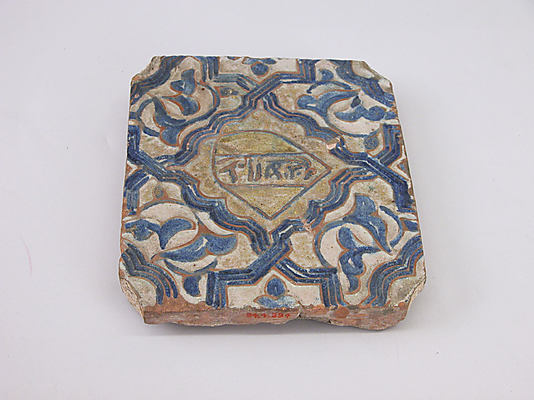
Tile
Date: second half 15th century
Geography: Spain
Image courtesy: The Metropolitan Museum of Art

Next week’s final post will look at the arts of the Ottoman Turks from the 13th century through 1924, arts of Iran from the 16th – 19th centuries and arts of the Mughals and later South Asia. In the meantime, I hope you all have an opportunity to browse through the many links in this post!

The Metropolitan Museum of Art: Galleries for the Art of the Arab Lands, Turkey, Iran, Central Asia, and Later South Asia – Part I

Josheen Oberoi explores the stunning new galleries of Islamic art at the Met, a few centuries at a time.

New York: It would be fair to warn visitors of a possible sensory overload when they visit the galleries presenting the Islamic Art collection of the Metropolitan Museum of Art in New York; not that it is a serious complaint considering the wealth of objects and information available for viewing. These collections have been mostly unavailable since 2003 when these galleries were closed for renovation. They opened again in November 2011 in an expanded space of fifteen galleries and have been feted far and wide.

The galleries are titled Art of the Arab Lands, Turkey, Iran, Central Asia, and Later South Asia.  When I visited, I was fortunate enough to speak with Maryam Ekhtiar, an Associate Curator in the Department of Islamic Art, who walked me through this space and introduced some highlights of the collection. In speaking of the nomenclature of the collections, she said, “the name of the galleries speaks to the parameters of our collection, our department’s collection”.  Instead of the overarching phrase “Islamic Art” that suggests a monolithic construction of an Islamic culture; this title is in fact a clue to the physical and historical reconfiguration of these galleries, and a particularly apt one in these times of misleading narratives of Islam worldwide.

Through the course of our conversation we walked chronologically through the numbered galleries (Galleries 450 – 464). Each of these galleries is defined both by geographical region and by time periods (from ca. 7th century AD through ca. 20th century), clearly illustrated in the handy map the museum shares with visitors.

Floor Plan of New Galleries
Image courtesy: The Metropolitan Museum of Art

However, part of the curatorial vision of this space is the interconnectedness of these galleries. There is no forced flow of traffic. As viewers, we are free to move between regions and eras as we wish, making our own connections. Of course I have to admit, I was grateful for the direction that the numbered galleries gave me as a first-time visitor. Following Dr. Ekhtiar’s flow of narrative optimized the experience for me while subsequent visits allowed for an even deeper engagement.

What follows is a textual replication of my experience and the highlights of Dr. Ekhtiar’s talk. Because of the extensiveness of this collection, the talk has been divided into three posts. This post will walk through galleries 450 – 453 and primarily cover the 7th through the 13th centuries of present day Syria, Iran and Iraq.

Errors, if any, are in my understanding:

We started with Gallery 450: This is an introductory gallery containing a gamut of objects that reference what you will encounter through the rest of the spaces: textiles, calligraphy, pottery, wood carved architectural elements. This gallery also contained designs and shapes that became increasingly familiar to me as we walked through the rest of the galleries.

One of the unifying elements in art from the Islamic world, found across centuries and geographic region is the use of text, in the form of calligraphy. It was one of the most revered forms of artistic expression because it was the means of transmitting the Qur’an in Arabic.

Folio from the “Qur’an of ‘Umar Aqta”
Object Name: Section from a non-illustrated manuscript
Date: late 14th–early 15th century (before 1405)
Geography: present-day Uzbekistan, Samarqand
Image courtesy: The Metropolitan Museum of Art

This is a folio from probably the largest Qur’an ever produced.  It is believed to have belonged to Tamerlane, the founder of the Timurid dynasty (late 14th–early 15th century, before 1405; Geography: present-day Uzbekistan, Samarqand). The story goes that the emperor wanted something unusual so the calligrapher took the tiniest Qur’an to him that required a magnifying glass to read. But the emperor was not impressed and so the calligrapher then created the largest Qur’an possible. This is in keeping with the Timurid world view, where everything must be larger than life and should be visible from a distance; case in point their monumental architecture. This Qur’an is now dispersed with various pages in different collections around the world.

Although many of us are familiar with the Islamic art of books, calligraphy was also used extensively as ornament in religious and secular contexts. It is not only used to convey messages but also beautify objects.

Bowl with Arabic Inscription
Object Name: Bowl
Date: 10th century
Geography: Iran, Nishapur
Image courtesy: The Metropolitan Museum of Art

This 10th century bowl from Iran (the Samanid dynasty, 10thcentury AD) is one such example. Extremely elegant, its beauty lies is its simplicity and the contrast between the black and the white. But this is a secular piece, with the proverb, “Planning before work protects you from regret”, written around its rim. Made of earthenware, a basic material, the white surface gives a sense of stoneware or porcelain ware of China.

Moving on to Gallery 451: Arab Lands and Iran in the Umayyad and Abbasid Periods (7th–13th centuries)

The shaded portion indicates the greatest extent of the Umayyad caliphate.
Image courtesy: The Metropolitan Museum of Art

The Umayyad dynasty(661 – 750 AD) was the first Islamic dynasty and was centered in Syria.

This gallery contains art from this dawn of the Islamic era. This is not to suggest a dramatic aesthetic break from this time onwards. On the contrary, it is in fact about the continuity with pre-Islamic traditions – in the west with the Byzantine and Coptic, and in the East with the pre-Islamic Persian and Sasanian, amongst others. This gallery celebrates both this continuity and the emerging distinctive vocabulary of Islamic culture.

Ewer with a Feline-shaped Handle
Object Name: Ewer
Date: 7th century
Geography: Iran
Image courtesy: The Metropolitan Museum of Art

This vase has a few very noteworthy elements to it. In shape, it resembles the elegance of a Sasanian vase but has mountain motifs that are typical of Central Asian and Chinese paintings. Interestingly, this motif is repeated on the surface. This element of repetition of pattern, calligraphic, vegetal, geometric, later became a prominent feature of art of Islamic culture.  The handle of the vase is another interesting feature because it is a feline stretched all the way, peering at ducks at the top. This central Asian vegetal pattern in a pre-Islamic shape allows it to fit into many historical parameters.

Panel from a Cenotaph or Symbolic Coffin with Marquetry decoration
Object Name: Panel
Date: second half 8th century
Geography: probably Egypt
Image courtesy: The Metropolitan Museum of Art

This work is probably a panel from a Cenotaph or Symbolic Coffin and shows an interesting conjunction of pre-Islamic eastern and Western traditions. It appears to be a two-dimensional rendering of a three-dimensional space. This is like a Byzantine mosaic, with arches but also winged columns that are Sasanian in nature. A very unusual find, this is a treasured object for the Met.

The second part of the gallery is the art of the cAbbasids, from their early period that is considered the Golden age (from 750 to 1250 AD). The cAbbasid caliphate succeeded the Umayyad dynasty and shifted the geographic center from Syria to Iraq, where Baghdad became the political capital, and Samarra, the second, princely capital. Many of the objects in this gallery were found at Samarra.

The shaded portion indicates the greatest extent of the Abbasid caliphate
Image courtesy: The Metropolitan Museum of Art

During this time, you see a new aesthetic approach emerging – the abstract vegetal designs repeating themselves, covering entire surfaces and a beveled design (so-called because of a certain, shallow slant in carving the surface) which is particular to this period and is found in many different mediums of plaster, stone, wood, ceramics, glass.

Bowl decorated in the ‘Beveled Style’
Object Name: Dish
Date: 10th century
Geography: present-day Uzbekistan, Samarqand
Image courtesy: The Metropolitan Museum of Art

It was a time of innovation and one of these innovations was the use of paint on ceramics.  Luster painting predated Islam in Egypt but it hadn’t been used on ceramics. In luster painting, once the surface has been decorated with pen or brush, the object is fired in a kiln, permanently fixing the design on the surface.

The Iraqi potters of Basra created these painted ceramics that looked like metal works (metal works were very expensive and reserved for royalty and wealthy people, ceramics were more easily available). This had a huge impact. Luster painted ceramics subsequently traveled from Iraq to Syria, Egypt and Iran, then to Spain, and from Spain to Italy and all over Europe having an enduring effect.

When the Abbasid caliphate started getting weaker, princely states started emerging. They all had their own rulers and ateliers but were still loyal to the Abbasids.  A few of these dynasties are represented in this gallery.  One of these dynasties is of the Samanids, referred earlier in Gallery 450, with their capital at Nishapur.

In the 1930s and 40s, the Metropolitan Museum of Art and the National Museum in Iran collaborated on excavation projects in Nishapur where every day architectural elements and objects of the Samanids were found. These were not meant for royal use.

Gallery 452 is a recreation of a 10th century room in Nishapur based on the architectural objects from these excavations, at a mound known as Tepe Sabz Pushan (“The Green-covered Mound”).

Gallery 452 – Nishapur and the Sabz Pushan Site
Image courtesy: The Metropolitan Museum of Art

Gallery 453: Iran and Central Asia (9th – 13th centuries)

This room focuses on the far-reaching impact of the Abbasid style in the eastern Islamic world and the princely states that rose around and after the Abbasids like the eleventh-century Ghaznavid and twelfth-century Seljuq Sultans. The Seljuqs (ca. 1040 – 1157) were of Turkic origin, from the steppes of Central Asia. They embraced Islam and took over Iran and the surrounding regions.

Seljuq sultanate in Iran, ca. 1080
Image courtesy: The Metropolitan Museum of Art

Incense Burner of Amir Saif al-Dunya wa’l-Din ibn Muhammad al-Mawardi
Ja`far ibn Muhammad ibn `Ali
Object Name: Incense burner
Date: dated A.H. 577/ A.D. 1181–82
Geography: Iran
Image courtesy: The Metropolitan Museum of Art

The Seljuq sultanate had very opulent courts and were very interested in figural art. There is a popular perception that figural art is forbidden in Islamic culture and that is inaccurate. It is not seen in public religious buildings and contexts but is seen widely in a secular context.

A wonderful example is this incense burner in the shape of a feline. The largest of its kind, it is inscribed, which is how the identity of the patron and the maker is known and so it can be dated to the 12th century. Constructed in two parts; it can be separated, filled up with incense and lit up and the fumes come out of the holes in the body of the feline.

Two Royal Figures
Object Name: Figure
Date: mid-11th century–mid-12th century
Geography: Iran
Image courtesy: The Metropolitan Museum of Art

The Two Royal Figures, these life size statues in the gallery, made of stucco, could potentially have been palace guards or princes. Scholarship on these figures is ongoing. The presence of jewels, the clothes and headdress suggests that they could have been princes. They have Central Asian features, as do many paintings on the ceramics in this gallery, because these dynastic rulers were of Central Asian origin and this was the ideal of beauty and it remained so in the Eastern Islamic world for very long, till the 17th century or later.

The Seljuqs were very innovative in terms of ceramics. An important development in that period was the introduction of stone paste as a medium for ceramics in Iran and surrounding regions. This was closest to porcelain (the material used to make porcelain was not available in the region till the 20th century) and was harder, whiter and easier to manipulate.

Ceramics in these galleries are made of stone paste. These ceramics have mina’i narratives from the art of books from the Shahnama, and princely portraits, audiences, and a variety of scenes. Mina’i meaning “enameled” was a laborious process and required firing the kiln many times.  These ceramics are also often seen with turquoise blue backgrounds, primarily because of the resources available there – copper and cobalt.

Dish with horse and rider
Object Name: Dish
Date: 13th century
Geography: Iran
Image courtesy: The Metropolitan Museum of Art

Coin
Reign: Jahangir (1605–27)
Date: dated A.H. 1034/ A.D. 1625
Geography: India, Agra
Image courtesy: The Metropolitan Museum of Art

This gallery also includes a thematic case of astrology and astronomy with multiple objects like the Iranian books of stars and Mughal gold coins with star signs like Libra, amongst other objects with astrological signs – signs that are still used and remain familiar to us.

Bowl with Astronomical and Royal Figures
Object Name: Bowl
Date: late 12th–early 13th century
Geography: Central or Northern Iran
Image courtesy: The Metropolitan Museum of Art

You can read more about the history of Islamic Art’s display at the Met prior to these galleries here.

We’ll explore some art from later Syria, Iran, Central Asia and Turkey in the next post. Stay tuned!