New Islamic Art Galleries at the Louvre

Guest blogger Saranna Biel-Cohen explores the stunning new galleries of Islamic art at the Louvre in Paris

Paris: Last year we featured a series of blog posts about the new Islamic wing of the Metropolitan Museum of Art in New York. 2012 was also the year of another significant opening in the world of Islamic art: Islam, at the Louvre in Paris.

Director of Islamic Art, Sophie Makariou explains the title was chosen to incorporate the expanse of the Islamic world throughout the centuries from Spain to India, The Empire of Islam, as it was known. Islam highlights cultural value of these works and their historical contribution spanning 1,300 years and three continents.

Bellini structure
Image credit: http://www.aasarchitecture.com

Bellini Structure
Image credit: nytimes.com

Comprising 18,000 objects dating from the 7th to the 19th century, the gallery explores the breadth and creativity of the civilization and is the largest collection of Islamic art in Europe. The collection is housed under an undulating structure made of aluminum and glass in the Louvre’s Visconti Courtyard, the most significant architectural addition to the museum since I.M. Pei’s glass pyramids of 1989. The project, by Italian architects Mario Bellini and Rudy Ricciotti, took six years to complete. Modeled on a silk scarf, the structure seems to float in mid air between the neoclassical buildings. Walking in to the gallery, there is an immediate sensation of being in a tent, with light pouring in from all sides.

The collection opens with an introduction to the Islamic world, beginning with the Prophet’s exile in 632 (Hegira in Arabic) and the subsequent conquest of Persia, Byzantium and beyond. The early period of Islam is represented by glass, metal and ceramics.

Vitrines of glass stamps, Egypt, 700

Vitrines of glass stamps, Egypt, 700

The gallery focuses on the intricacies of decorative texts on religious and secular objects and its various influences. Arabic writing predates Islam by a century. Then different forms of writing, Qu’ranic script and secular were used to adorn pieces, describe their function or offer protection to an object. The later incorporation of Persian, an indo-European language, further developed the use of decorative text and many objects with Persian poetry are on view. Read more about decorative calligraphy here.

A sleek, industrial looking metal staircase leads to the lower-ground floor. Large Turkish mosaics greet you at the bottom. They were found by a team of French-American archaeologists in the 1930s at Antioch (Antakya), once the capital of Syria, in the residential neighborhood of Daphne. A Roman tradition, mosaic making spread across the Roman Empire and was then used by subsequent civilizations for religious, public and private use.

Phoenix Mosaic, Antakya, 6th Century

Phoenix Mosaic, Antakya, 6th Century

This particular mosaic depicts a phoenix, a mythical bird that rises from ashes, bordered by pairs of ram heads. It was discovered in 1936 almost completely intact. Greek and Roman classical sculpture can be found in a two small rooms above the mosaics. Statues of Greek and Roman gods are housed there, a memory of an earlier civilization that had occupied parts of the region covered in the rest of the galleries.

Marble sculpture of goddess, Artemis, Akshehir, Turkey, 2nd Century

Marble sculpture of goddess, Artemis, Akshehir, Turkey, 2nd Century

There are large vitrines of Egyptian textiles dating from the 6th century. They bear Roman and Byzantine iconography that later evoked Christian interpretations. Cherubs picking grapes, playing instruments and dancing references the Roman god of wine, Bacchus while Christians interpreted this theme of wine as reference from a passage from the Gospel of John in which Jesus is a vine and God the vine grower.

Cupid Picking Grapes
Linen and wool tapestry, Egypt, 6th Century

The Islamic conquest of Persia (633–656) ended the Sassanid Empire. Iran became a part of the Islamic Empire and many of the objects in the gallery are associated with the mix of cultures that ensued.

Ceramic stars, Iran, c. 665

Ceramic stars, Iran, c. 665

Hughes Dubois/Musée du LouvreA silver and gold inlaid casket, Iran, 14th-century

A silver and gold inlaid casket, Iran, 14th-century
Image credit: Hughes Dubois/Musée du Louvre

The Islamic Empire expanded west to Spain and east to India. By the 16th century the Islamic world made up 30% of the global population.

Carved ivory pyxis of al-Mughira, Cordoba, c. 968
Image credit: Hughes Dubois/Musée du Louvre

Wood doors inlaid with ebony and ivory, Egypt c. 1380-1420

Wood doors inlaid with ebony and ivory, Egypt c. 1380-1420

An extensive collection from the Mughal Empire (about 1526-1858) includes intricate armor, elaborate daggers, ceramic tiles and Indian carpets. Many of the carpets were made in factories founded by Emperor Akbar (1556-1605) in Fatehpur Sikri, capital of the Mughal Empire for only about 10 years. To learn more carpets, click here.

Philippe Ruault/Musée du Louvre

Louvre Islamic Galleries
Image credit: Philippe Ruault/Musée du Louvre

Indian carpets

Indian carpets

Jade dagger with horse head handle inlaid with rubies, emeralds and gold, MughalPeriod, 17th CenturyImage credit: www.bbc.co.uk

Jade dagger with horse head handle inlaid with rubies, emeralds and gold, Mughal
Period, 17th Century
Image credit: http://www.bbc.co.uk

The Ottoman Empire (14th–20th Century) stretched from the Balkans and Anatolia, around the Mediterranean basin, and as far as Morocco. Ottoman carpets are displayed, as well as large and small scale Iznik ceramics.

Ottoman ceramic wall, Turkey, c. 1560–80Image credit: Raphaël Chipault /Musée du Louvre

Ottoman ceramic wall, Turkey, c. 1560–80
Image credit: Raphaël Chipault /Musée du Louvre

Funding for the 98 million Euro gallery was provided by the French government and supported by endowments from Saudi Arabia, Morocco, Kuwait, Oman and Azerbaijan. Of the 18,000 objects in the collection, 3,000 are currently on view and 300 objects will move to the Louvre Abu Dhabi in 2017.

Guest contributor Saranna Biel-Cohen lives and works in London. She holds a Master’s Degree in History of Art from University College London with a focus on Modern Indian Art.

A Word of Thanks & Happy 2013!

Dear Readers,

Here’s wishing you a very happy and prosperous 2013 ! The past year was an eventful one for Saffronart as we introduced an array of new categories and collectibles by way of our auctions and The Story, our new website featuring unique objects in curated collections available for sale every day!

Happy New Year from Saffronart

It was also the inaugural year for our blog launched in April of 2012. In a span of six months, we have come a long way with a readership of 1600 plus. We were happy to feature exciting reviews reports and interviews through this course. Some highlights included a guest post on Arpita Singh’s New York solo exhibition at the DC Moore Gallery, a series of walk-throughs of the Metropolitan Museum’s new Islamic galleries, a review of Zarina’s solo show at the Hammer Museum, interviews withTarun Tahiliani and Shilpa Shah of the TAPI Collection, as well as collectors like Anupam Poddar,and Kamran Anwar weighing in on their favorite lots from our inaugural Pakistani  auction. Other exciting conversations included one between guest blogger Diana Campbell, artist Rathin Barman and gallerists Priyanka and Prateek Raja, an interview with the Director of the ARKEN Museum in Copenhagen and with Beth Citron, the curator of the Rubin Museum on their exhibition program dedicated to Modern Indian Art as also one with  Sarnath Banerjee about his London public art project, ‘Gallery of Losers’.

We thank you for your support and look forward to bringing timely and engaging news, interviews, images and more from our offices around the world. A special word of thanks for our guests bloggers for their contributions. We hope our regular posts on this blog continue to offer you new insights into the products we feature in our online auctions, new ideas about collecting, and also a new perspective on Saffronart.

Best wishes,

Team at Saffronart Blog

Antique Writing Boxes

In conjunction with the uniquely crafted Indian and Chinese boxes featured in The Story by Saffronart, Medha Kapur shares a note on Antique Writing Boxes or Lap Desks 

An Organizer Table
The Story by Saffronart

Mumbai: Writing boxes or lap desks have existed for many centuries and in many cultures. More of a personal possession than the writing desk or table, these were mainly used by men and were also a symbol of social status. Essentially, writing boxes were small enough to be carried anywhere and often traveled with the owner. Antique lap desks had hinged writing surfaces, often covered in leather or felt, that flipped up to reveal storage space for papers. Individual compartments were designed to hold inkwells, pens, sealing wax, and other writing implements. Some desks also had concealed storage compartments.

From the late 1700s, writing boxes were frequently used in military expeditions and travels, besides libraries and drawing rooms. Several famous pieces of literature, contracts, letters and postcards have been penned on them. These boxes were hugely popular among army officers, who used them to write letters to their loved ones, as well as for business.

In the middle of the 18th century, with industrialization, land reforms, new mechanical inventions and expanding overseas trade coming into play, there was a need for goods to be transported. This led to a boom in personal travel as well. Portable writing boxes became obligatory for more people as they transacted, traveled or wrote letters from home. Education was revived on many levels of society to cope with the new needs. These boxes were an item that connected with intellectuals; however, the style, quality, ornament and form of the desk also played an important role.

Thomas Jefferson's Desk-1776

Thomas Jefferson’s Desk-1776

Thomas Jefferson conceptualized a design for a small lap desk that could be taken anywhere. This desk, one of numerous inventions Jefferson devised for his own convenience, was designed in May 1776 and built by Benjamin Randolph, a Philadelphia cabinetmaker and prominent patriot. Randolph built the desk for Jefferson based on his plans, using solid mahogany with inlays at both ends. Though small, the desk must have proved a very difficult project, with lots of fine, delicate details to be taken into account. The desk, being small and portable, provided the perfect companion to Jefferson during his travels, allowing him the comfort of reading and writing wherever he roamed. Many of Jefferson’s letters, memos and papers were composed on the desk, and it was also used in the drafting of the Declaration of Independence. Jefferson carried the desk with him until the year he died – at which point it was passed on to his grandson-in-law, Joseph Coolidge.

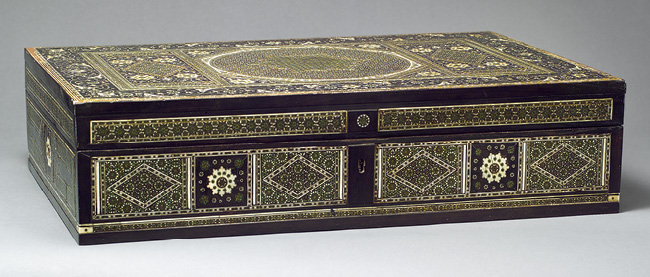
Another interesting writing box from the permanent collection of the Metropolitan Museum of Art in New York is a late 16th or early 17th century example from India, probably Gujarat or Sindh. This box consists of sections made from diverse materials including tin, wood, ivory and bone.

Writing box from the Metropolitan Museum of Art

Writing box from the Metropolitan Museum of Art

Similar to these pieces is the unique Munim Chest or money lender’s box, part of the collections Boxed on The Story by Saffronart.

Munim Chest

Munim Chest
The Story by Saffronart

Munim Chest

Munim Chest
The Story by Saffronart

The Metropolitan Museum of Art: Galleries for the Art of the Arab Lands, Turkey, Iran, Central Asia, and Later South Asia – Part V

Josheen Oberoi of Saffronart explores the stunning new galleries of Islamic art at the Met, a few centuries at a time.

New York: This is the last in a series of posts that came out of my visit to the Islamic Art collection at the Metropolitan Museum of Art in New York and a consequent conversation with Dr. Maryam Ekhtiar, an Associate Curator in the Department of Islamic Art there.  This art collection is presented in fifteen new galleries that opened to the public after an eight year renovation in November last year.

The galleries are titled Art of the Arab Lands, Turkey, Iran, Central Asia, and Later South Asia. Dr. Ekhtiar, in speaking of the nomenclature of the collections, said, “the name of the galleries speaks to the parameters of our collection, our department’s collection”.  Instead of the overarching phrase “Islamic Art” that suggests a monolithic construction of an Islamic culture; this title is in fact a clue to the physical and historical reconfiguration of these galleries, and a particularly apt one in these times of misleading narratives of Islam worldwide.

Through the course of my conversation with Dr. Ekhtiar we walked chronologically through the numbered galleries (Galleries 450 – 464) that are organized by geographical regions and time periods (from ca. 7th century AD through ca. 20th century). I have followed the same chronology here, bringing us today to the last two galleries 463 and 464 showing Mughal and later South Asian art.

Here’s the very useful museum map again, to help follow the information:

Floor Plan of New Galleries
Image courtesy: The Metropolitan Museum of Art

We haven’t discussed South Asia previously but the time period (16th – 20th centuries) that we will look at today is contemporary to the arts of Safavids and later Iran and the overlap and exchange of culture is visible in the artistic forms of the time as well. Gallery 463, for example, presents the arts of the Sultanate, Mughal and Deccan courts from about 1450 through the nineteenth century. This gallery contains an extensive selection of jeweled arts that were practiced in South Asia, including jade carving (which was highly prized in China and was part of a commercial exchange with it). But like in Gallery 462, the two object forms that immediately capture attention are the carpets and the illustrated manuscripts’ folios.

Carpet with Scrolling Vines and Blossoms
Object Name: Carpet
Date: ca. 1650
Geography: Northern India or Pakistan, Kashmir or Lahore
Image courtesy: The Metropolitan Museum of Art

The scrolling vegetal designs that we saw in last week’s post are visible in the image on the left as well. The carpet below, on the other hand, with a niche that nestles a flowering plant, appears to be designed vertically and possibly for hanging on the wall rather than laying on the ground.

Carpet with Niche and Flower Design
Object Name: Carpet
Date: mid-17th century
Geography: India or Pakistan, Kashmir or Lahore
Image courtesy: The Metropolitan Museum of Art

Interestingly, these styles remained active in the Iranian and South Asian regions. The early 20th century example below, from a Saffronart auction in March this year displays a combination of these design details – the visible Arabesque niche in the carpet is occupied by intricate and delicate flora and fauna, surrounded by a border.

“Akbar Hunting with Cheetahs”, Folio from an Akbarnama
Painting attributed to Manohar (active ca. 1582–1624)
Object Name: Illustrated album leaf
Date: ca. 1604
Geography: India
Image courtesy: The Metropolitan Museum of Art

Illustrated manuscripts, similarly, remained an active part of the region through the 20th century as indicated by the folios on display in this gallery and in Gallery 464. Akbar, considered the greatest Mughal rulers (r. 1556 – 1605), established royal ateliers and commissioned illustrated manuscripts, including the Akbarnama that was a chronicle of his reign.

His successors Jahangir (r. 1605-27) and Shah Jahan (r. 1628-58) continued this patronage,an example of which is the exquisite Padshahnama, or the Shah Jahan Album illustrated through the 1640s. These reigns saw a diversity of manuscript production that included Indian, Persian and European elements (like linear perspective and European motifs). A few of the folios shown below evidence this multitude of subjects like studies of animals, flora and fauna, portraiture,mythological narratives that were produced simultaneously at that time. It also underlines the development of a unique idiom within the South Asian region in the arts of the book both linking it to and distinguishing it from the Safavid and later Iran workshops.

“Rama Receives Sugriva and Jambavat, the Monkey and Bear Kings”, Folio from a Ramayana
Object Name: Folio from an illustrated manuscript
Reign: Akbar (1556–1605)
Date: ca. 1605
Geography: India
Image courtesy: The Metropolitan Museum of Art

Madonna and Child in a Domestic Interior
Painting by Manohar (active ca. 1582–1624)
Object Name: Illustrated single work
Date: early 17th century
Geography: India
Image courtesy: The Metropolitan Museum of Art

“Shah Jahan on a Terrace, Holding a Pendant Set With His Portrait”, Folio from the Shah Jahan Album
Painting by Chitarman (active ca. 1627–70)
Object Name: Album leaf
Reign: Shah Jahan (1628–58)
Date: recto: 1627–28; verso: ca. 1530–50
Geography: India
Image courtesy: The Metropolitan Museum of Art

“Black Buck”, Folio from the Shah Jahan Album
Painting attributed to Manohar (active ca. 1582–1624)
Object Name: Album leaf
Reign: Jahangir (1605–27), recto
Date: recto: ca. 1615-20; verso: ca. 1530–50
Geography: India
Image courtesy: The Metropolitan Museum of Art

Adventures of Hamza or the Hamzanama was another narrative commissioned by Akbar that recounted the stories of Hamza, an uncle of Prophet Mohammad.

“Misbah the Grocer Brings the Spy Parran to his House”, Folio from a Hamzanama (The Adventures of Hamza)
Attributed to Dasavanta
Artist: Attributed to Mithra
Object Name: Folio from an illustrated manuscript
Reign: Akbar (1556–1605)
Date: ca. 1570
Geography: India
Image courtesy: The Metropolitan Museum of Art

Both Galleries 463 and 464 also have folios from the Islamic Deccan courts and later 19th century court arts of the Jain, Rajput, Pahari and “Company” style paintings. These are placed in conjunction with the Islamic art galleries to  accurately represent the continuum of South Asian art, not compartmentalized by religion. There was a rich dialog between the two contemporaneous traditions that is visible throughout these galleries.

For example, the image below on the left, of a nobleman on a terrace is an 18th century folio from a late Islamic Mughal center in Bengal, and on display in these galleries. The image on the right, from a Saffronart auction in April this year is the portrait of a Hindu Bikaneri maharaja. Such cross currents in portraiture, amongst other subjects, is a constant in these artistic traditions.

Portrait of a Maharaja
Late 17th Century
Bikaner School

Nobleman on a Terrace
Object Name: Illustrated single work
Date: ca. 1780
Geography: India, Murshidabad
Image courtesy: The Metropolitan Museum of Art

Ragamala paintings, also available for viewing, are a pictorial narrative mode for musical notes (ragas) that originated in the Islamic Deccan kingdoms but found their way to the ateliers of princely states in Rajasthan.

And finally, the “Company” school paintings, shown in Gallery 464 often documented the flora, fauna, topography and people of the land. These watercolors were commissioned by the British and executed by Indian painters in a European style.

Chronologically the last space in the newly configured galleries that we have been visiting over the last few posts, Gallery 464 can also be physically entered and understood independent of the remaining galleries.However, that is true of any of the fifteen galleries. Choosing your personal path through these spaces engenders a distinct experience each time.

Text (calligraphy), shapes (geometric, vegetal, figural, flora, fauna, zoomorphic), materials (ceramic, wood, metals, paper, textile), techniques (luster-painted, gilded, enameled, painted, carved), objects (utilitarian, luxurious,  decorative, religious) – these are just a few of the forms that can be conceptually and visually followed through these galleries. Recurring, in various ways, in various objects, they tell a story of a cultural continuum, not an overarching structure – this is a testament to the impeccably curated experience of these new galleries.

I hope you’ve enjoyed this ride with me. The Saffronart blog hopes to keep taking you along for more of these!

The Metropolitan Museum of Art: Galleries for the Art of the Arab Lands, Turkey, Iran, Central Asia, and Later South Asia – Part IV

Josheen Oberoi of Saffronart explores the stunning new galleries of Islamic art at the Met, a few centuries at a time.

New York: Last month I had started posting about the Islamic Art collection of the Metropolitan Museum of Art in New York that opened to the public after an eight year renovation in November last year. For those reading this series for the first time, here is a little introduction to these new galleries. Organized by geographical regions and time periods (from ca. 7th century AD through ca. 20th century), these fifteen new galleries (Galleries 450 – 464) present historically rigorous exhibits of arts that flourished under the aegis of Islamic rulers through many centuries. These galleries are also incredible in representing the diversity of mediums and contexts of these artistic practices.

In my last post, I had described the highlights of Galleries 459 through 461, that present the arts of the Ottoman Empire (ca 1299 – 1922), as shared with me by Dr. Maryam Ekhtiar, an Associate Curator in the Department of Islamic Art.  Here’s the very useful museum map again, to help follow the information:

Floor Plan of New Galleries
Image courtesy: The Metropolitan Museum of Art

Today, I look at Gallery 462 and its arts of Safavids and later Iran (from the 16th – 20th centuries). We have followed Iran from the 7th century onwards from Galleries 451, 453 and 455 and this gallery brings our understanding of art from the region almost to contemporary times

Iran was united and ruled by the Safavid dynasty from 1501  -1722.  Shah cAbbas who ruled from 1587–1629 was an important patron of the arts and this period saw an expansion and revival of production in arts for local consumption and commercial exchange with Europe. Ceramics in the style of Iznik pottery from Turkey that we saw in the last post and luster ware that has also been discussed previously were both encouraged extensively as is visible in the objects in this gallery.  But when you enter this space, there are a few works of art that dominate the conversation – the carpets and the illustrated manuscripts.

Persian Garden Carpet
Object Name: Carpet
Date: second half 18th century
Geography: Iran, Kurdistan
Image courtesy: The Metropolitan Museum of Art

Under Shah cAbbas, carpet weaving and textile production was transformed into a state industry, designed and produced in royal workshops at the new capital of Iran – Isfahan, in southern Iran. There are many different types and styles of carpets on exhibit here – medallion, garden, a possibly royal carpet, the “Polonaise” and carpets known as ‘Portuguese carpets’.

The Persian garden carpet or the char-bagh, (on the left)  represented a bird’s eye view of a traditional garden, which included water channels, fish swimming in these channels, birds and trees.

The “Seley Carpet” below, in style of a medallion carpet, is an exquisite example of the combination of medallion and vegetal motifs. These carpets centered around a medallion, similar to what appeared on book covers and texts, suggesting a cross pollination of designs between different art forms. These medallions were then surrounded by scrolling vegetal designs.

The Seley Carpet
Object Name: Carpet
Date: late 16th century
Geography: Iran
Image courtesy: The Metropolitan Museum of Art

This ‘Portuguese’ carpet below shows the central medallion with floral vines combined with explicit maritime scenes with ships sailed by Europeans in the four corners, possibly testifying to an active export and mercantile exchange between Europe and Iran at this time. Just these few examples of the pieces exhibited in this gallery showcase the complexity and diversity of carpet production in Iran at this time, especially under Shah cAbbas.

“Portuguese” Carpet with Maritime Scenes
Object Name: Carpet
Date: 17th century
Geography: Northeastern Iran, Khurasan
Image courtesy: The Metropolitan Museum of Art

“Rustam’s Fourth Course, He Cleaves a Witch”, Folio from the Shahnama (Book of Kings) of Shah Tahmasp
Abu’l Qasim Firdausi (935–1020)
Artist: Painting attributed to Qadimi (active ca. 1525–65)
Object Name: Folio from an illustrated manuscript
Reign: Shah Tahmasp (1524–76)
Date: ca. 1525
Geography: Iran
Image courtesy: The Metropolitan Museum of Art

The other highlight in Gallery 462 are the intricate folios of the Shahnama or “Book of Kings”. This is one of the great treasures from the rule of Shah Tahmasp (r. 1524 – 1576)  the second ruler of the Safavid dynasty. It was commissioned and made in the royal workshop. The Shahnama is a Persian national epic based on an oral tradition that dates back to pre-Islamic times and was versified by Firdausi in the early 11th century. It contains within many Zoroastrian threads with the ideas of polarities, of good and bad – an illustration also intended as education to the rulers and princes. This particular manuscript of the Shahnama is the most luxurious Persian manuscript ever produced and the best artists were employed by the royal workshop – painters, calligraphers, binders, illuminators with two generations of artists working on these manuscripts. The Met has 78 illustrations out of a total of 258 illustrated folios, presenting epic love scenes, battles of fantastical creatures with humans or among animals. There are multiple folios on display at any time in the gallery, with seating available to engage with them at leisure.

If you visit please do set aside some time for these folios. They are intimate in size but so detailed and beautifully rendered. I find myself noticing new details in them with each successive visit.  I have also been linking the title of each work (immediately under the image) to it’s individual museum page. This allows you to zoom in and look at enlarged sections clearly. If you cannot visit the museum, I would recommend using this feature to do the images justice, especially for today’s post.

Next week, in the last post in this series, we will visit the remaining two (out of fifteen) galleries, showcasing Mughal and later South Asian art. Stay tuned!