Pearls: The Queen of Gems

Amy Lin of Saffronart explores the origins of pearls in relation to some of the opulent pearls featured in this month’s Auction of Fine Jewelry & Watches

Lot 44: A NATURAL PEARL AND DIAMOND BROOCH
Centering on an off-round natural pearl, weighing 14.70 carats, to a surround of collet-set natural diamonds
Auction of Fine Jewels & Watches (OCT 30-31, 2012)

New York: From Cleopatra drinking a pearl dissolved in a cocktail to prove Egypt’s worth, to Queen Elizabeth I adorning her garments with pearls as the symbol of feminine virtue, these illustrious jewels have rightfully claimed their title as the “Queen of Gems.” Besides their timeless elegance and seductive luster, the origins of pearls are miracles in themselves.

Lot 45: A FIVE-STRAND NATURAL PEARL NECKLACE
Designed as five gently graduated strands of 675 natural pearls, weighing approximately 545.12 carats in total, and measuring between approximately 8.49 mm and 3.62 mm, joined by a clasp set to the center with an oval-shaped diamond, weighing approximately 2.78 carats, mounted in gold
Auction of Fine Jewels & Watches (OCT 30-31, 2012)

Saffronart is pleased to feature several important pearls in our upcoming Auction of Fine Jewels & Watches, including a majestic natural pearl and diamond brooch. At 14.70 carats, its impressive size is a rare beauty, with a garland of diamonds that enhances its luminosity. Another important piece is a five strand natural pearl necklace fashioned out of 675 natural pearls, weighing approximately 545.12 carats in total, recalling some of the legendry strings of pearls worn by royals all over the world.

The pearl is the one of the few gems that are cultivated in a living organism. Pearls are usually divided into two broad categories, natural and cultured.  Natural pearls are formed when foreign objects enter a mollusk such as an oyster or mussel. Over time, the organisms coat the objects with a substance called nacre and build up layers until a pearl is formed. Cultured pearls are created in a similar way, except the foreign objects are introduced manually into mollusks in pearl farms. It is much more difficult for pearls to form in nature given different environmental factors; therefore natural pearls are valued much higher than cultured pearls.

Pearls in Oyster Shell
Image Credit: http://jasonofbh.com/?p=5700

It is a common misconception to believe that pearls are perfectly round. Pearls, especially large ones, are rarely rounded. They can be off round or baroque, which refers to irregular and unique shapes. In addition, the size of the pearl depends on how long it remains in the organism, the chemistry and the temperature of the water. Large, round pearls are extremely rare, both natural and cultured, often commanding high prices.

The captivating elegance of pearls has attracted both kings and queens around the world, and India is no exception. Surprisingly, the biggest pearl patrons in India were not its queens, but its long succession of Maharajas. One of the most divine pieces in the collection of the royal family of Baroda, for example, was the seven-strand pearl necklace known as the “Baroda Pearl Necklace.”  Documented by distinguished photographers since its creation in the 19th century, it was also published in George Frederick Kunz’s seminal 1908 volume, “The Book of Pearl.” The necklace once again attracted international attention when Maharaja Pratapsingh Rao Gaekwad was photographed by Henri Cartier Bresson wearing it.

Here are some more pieces featuring pearls in the upcoming auction. 

To learn more about pearls, browse through our Jewelry Guide. 

Maharajah Pratapsingh Rao Gaekwad wearing the Baroda pearl necklace. Maharani Sita Devi making adjustments to the necklace.
Photograph By: Henri Cartier Bresson
Image Credit: http://www.internetstones.com/baroda-pearl-necklace-maharajah-khande-rao-gaekwad.html

Cocoa-Coloured Diamonds

Medha Kapur from Saffronart shares a note on brown diamonds

Brown DiamondsDiamonds have always been the most sought-after gems on earth, and for centuries, these precious stones have been desired and coveted across various cultures and geographies. I think “loving diamonds” is in a woman’s DNA. There’s no better way to stand out from the crowd than wearing a bold accessory with a bit of sparkle and. The diamond is a symbol of privilege, and like snowflakes, no two are exactly alike. Each has specific qualities that establish its value. Occasionally, nature will get creative and produce a diamond with almost magical colors: blue, pink, deep yellows and even green hues. Fancy-colour diamonds are highly prized, and even more so if their colour is the result of natural processes.

Recent celebrity fascination with fancy coloured diamonds may also account for the sudden spiral in their popularity. According to the GIA, the demand for coloured diamonds has increased 102% since 1999.

Lorraine Schwartz Brown Diamond Bracelet

Lorraine Schwartz Brown Diamond Bracelet

This season, yellow and brown coloured diamonds seem to be very popular, and it is no surprise that jewelers are dipping into this new champagne-coloured fashion trend! You will find plenty of variety in brown diamonds, from the “champagne” (lightly tinted) to the darker “cognac” diamonds, and each is a must have in one’s jewelry collection! The key to wearing browns diamonds is to go for a contrast. Warm toned coloured diamonds pair best with the brilliance of colourless diamonds!

Lea Michele’s Brown and White Diamond Mesh Necklace.

Lea Michele’s Brown and White Diamond Mesh Necklace.

Saffronart’s Autumn Online Auction of Fine Jewels & Watches on October 30-31, features an important necklace and pair of ear pendants set with brown and colourless diamonds. The necklace features two striking rows of round full-cut diamonds and diamond baguettes, and spacers set with marquise-shaped diamonds, which suspend a graduated fringe of coloured diamond briolette beads. The earrings are of a similar design, but versatile, in that the cluster of coloured diamond briolettes suspended from each can be removed, so they may be worn differently. This suite is one of those statement pieces that’s sure to garner glances and envy whenever and wherever you wear it!

brown and colourless diamond necklace

Saffronart’s Autumn Online Auction of Fine Jewels & Watches

Blue Velvet: The Myth of the Kashmir Sapphires

Amy Lin of Saffronart explores the significance of the Kashmir sapphire in this month’s auction of Fine Jewels & Watches

Lot 25: AN UNMOUNTED NATURAL KASHMIR SAPPHIRE
A cushion-shaped modified brilliant and modified step cut sapphire, weighing 11.15 carats
Auction of Fine Jewels & Watches (OCT 30-31, 2012)

New York: At 11,000 feet above sea level, miners risk dangerous situations to procure one of the most precious gemstones in the world, the Kashmir sapphire. Kashmir sapphires retain a brilliant, dreamlike blue colour that captivated the hearts of kings and civilians alike. Some call these stones ‘blue velvet’, while others simply know them as the rarest sapphires in the world.

We are proud to feature a magnificent 11.15 carat Kashmir sapphire in this month’s auction of Fine Jewels & Watches. The gem is cushion shaped, with step cuts that illuminate its radiance. Its un-mounted nature allows designers and jewelry lovers countless ways in which to set it in a unique ring, brooch or pendant.

Sapphires are part of the mineral corundum family, and carry traces of aluminum oxide. Although they come in different colours, the most famous and sought after are blue sapphires that carry hints of titanium. Besides their brilliance, sapphires are extremely resilient, placing them second only to diamonds on the Mohs Hardness Scale. The value of sapphires is determined by their colour, purity, reflection and size.

The Maharaja of Jammu and Kashmir, late 19th century
Photographer: Deen Dayal
Image Credit: http://www.oldindianphotos.in/2012/02/maharaja-of-jammu-and-kashmir-late-19th.html

Sapphires were first discovered in Kashmir in the 1880s, when a landslide revealed a mineral deposit of exceptional quality and size. The British Indian geologist F.R. Mallet was hired to indentify the stones, which turned out to be sapphires like no other. He recorded his discovery in the Manual of Indian Geology at the Indian Museum. Upon hearing about the blue gems in his region, the Maharaja of Kashmir sent troops to secure the mines but allowed his subjects to keep the ones previously extracted. From 1882 to 1887, Kashmir flourished as riches spilled into the kingdom.

Before long, heavy mining led to the decline of profits and the depletion of resources.  Although evacuations have been led to find other mines, none could rival the quality of the first. In modern times, the Indian Himalayas have seen a lot of guerilla warfare. Therefore, whether additional deposits of Kashmir sapphires are still hidden underground is a matter of speculation. It is without a doubt that the sapphires from Kashmir’s early mining days are the best in the world in terms of their colour and size. Their unique, intertwining crystals give them a hazy, hypnotic quality that evokes dreams and mysticism. Because of their short mining debut, they are one of the rarest gems in the world, making them a true collector’s item.

More Silver for your Gold: Strong Demand for Indian Silver Abroad

Amy Lin of Saffronart reports on a likely 35% increase in silver exports from India in the coming year 

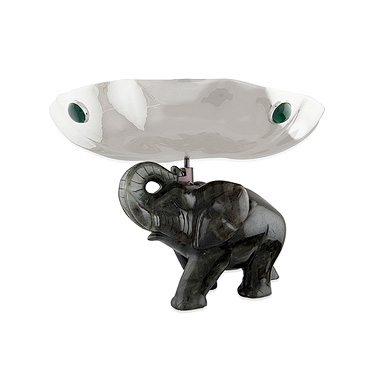
An ‘Elephant’ Dish
Created in 2012
Contemporary & Period Silverware Sale, Saffronart Delhi

Saffronart recently concluded its Exhibition of Contemporary & Period Silverware in Delhi. Some pieces are still available for purchase on the website.

Mumbai: In recent Dhanteras festivals, the most popular precious metal amongst consumers is not gold, but silver. Dhanteras is the first day of the Diwali celebrations on which buying precious metals is seen as an auspicious sign of wealth. P.S. Singhvi, a 50 year old businessman stood in line with more than a hundred people waiting to buy silver coins at Mumbai’s busy Zaveri Bazaar. He told The Financial Express, “We are interested in silver coins for mahurat (auspicious) trading. We can buy more silver for a lesser amount. For gold we will have to pay a high amount.” It seems that the potential value of silver is no longer a secret in India but has caught on with the rest of the world.

For three consecutive years, the demand for Indian silver continues to grow worldwide. This is due to skyrocketing gold prices, and the slowdown of manufacturing. Rajiv Jain, chairman of the Gems and Jewellery Export Promotion Council (GJEPC), estimated that the export for Indian silver will increase by 35% in the 2013 fiscal year.

Small-sized silver bars and coins dominated festival sales in India.
Image Credit: Reuters
http://www.financialexpress.com/news/silver-dominates-festival-sales-in-india/865147/5#

Already in 2011, an article from Bloomsburg News championed silver as the “common man’s gold.” Ketan Shroff, managing director of Pushpak Bullions Pvt. stated, “People are accumulating silver since gold is getting unaffordable to the common man.” Consequently, the common man’s demand has a strong reflection on the world market. From 2011-12, silver exported from India increased to 44% while gold exports remained at 30%. There are a lot of investments to be made in silver as an average overseas consumer can purchase quality silver pieces for less than $100 (Rs. 5,200).

In response, the import of silver to India has also increased as a response to demand. Prithviraj Kothari, president of the Bombay Bullion Association, stated in The Wall Street Journal last February that “India’s silver imports may top 5,000 metric tons in 2012 due to strong investment demand” compared to the 4,800 metric tons in 2011.

Shroff enthusiastically stated in India Times, “The trend is fast picking up. Investors and jewellery lovers prefer more of silver jewellery as gold prices go up consistently. If the positive sentiments can keep up the pace, silver prices may go over Rs 1 lakh, beating last year’s Rs 75,000 levels.”  With such prospects, silver may no longer be the common man’s gold but a precious metal just as valuable if not more.

A Tea and Coffee Set
Contemporary & Period Silverware Sale, Saffronart Delhi

My Introduction to Art Deco

Medha Kapur of Saffronart responds to some of the lots coming up in our Art Deco Auction

Mumbai: It seems these days that all sorts of old styles are coming back into fashion! The design style known as Art Deco began in Paris in the 1920s, and has made several comebacks since. These days Art Deco fashion, jewelry, and even furniture are all the subject of new trends. Working at Saffronart, I have met some very creative individuals and major fans of the Art Deco period.

Deco is a strong, beautiful style. Its typical attributes include geometric shapes, bold curves, strong lines, aerodynamic forms, and sunbursts galore. A distinct departure from previous design styles, Deco evoked elegance and modernity. It was also influenced by the increased ability to travel, inspired not only by modernism, but by the cultures of faraway places such as Egypt, China and Japan.

Saffronart is holding its inaugural Art Deco auction on October 31-November 1, 2012. The idea is to showcase the Art-Deco style, which defined South Bombay in the 1920s and 30s, and is now synonymous with its unique heritage. This auction will also help raise awareness and funds for Mumbai’s bid to nominate its Art-Deco and Victorian precincts as a UNESCO World Heritage Site. Saffronart and its consignors have committed to donating 5% of the proceeds from the sale of select lots to this cause.

The auction will feature original furniture, timepieces, accessories and jewelry. I was completely floored by one of the furniture pieces in the sale, a rare lady’s vanity. What grabbed my attention was the story behind it! The piece is likely to have belonged to a distinguished Indian lady, and was probably used as a travelling dresser during long cruise-liner voyages to Europe, extended stays at summer homes in the hills, and in luxury tents during the ‘shikar’ or hunting season. Sounds quite majestic!

lady’s vanity case

lady’s vanity case

Another evocative and glamorous piece in this auction is a custom-designed bracelet watch in 18 K gold with diamond accents. This watch was made for the Princess of Jodhpur, and included as a part of the Indian traditional dowry system when she got married to the Yuvraj of Baroda. The splendid provenance of this fine wristwatch makes it a coveted acquisition, as the royal house of Baroda is synonymous with style and refinement.

Wristwatch from the estate of the late Maharani Padmavati Devi Gaekwar of Baroda.

Universal Geneve wristwatch from the estate of the late Maharani Padmavati Devi Gaekwar of Baroda.

Despite having a very specific look and feel, Art Deco objects seem to have a modernism about them that makes their appeal quite timeless. There are certain styles that will never go out of fashion, and I believe Art Deco is one them!