The Chronicles of Pearls

Shradha Ramesh shares a note on “Pearls” an exhibition jointly organized by the Victoria and Albert Museum and Qatar Museums Authority

New York: From time immemorial the smooth, luminous and iridescent gem – the pearl, has been one of the most sought after the world over. Its significance can be gauged by the multiple historical accounts that celebrate its aura, which captivated different personalities spanning time periods and cultures. It is believed that Cleopatra dissolved a single pearl in a glass of wine and drank it, simply to win a wager with Mark Antony that she could consume the wealth of an entire nation in just one meal – such was its lure.

Pearls are likened to the cornucopia of beauty, wealth and social status. Men and Women across history have been enchanted by this gem of the sea.  A natural pearl is created, as a protective biological reflex to foreign particles that irritates the oyster. Nowadays oysters are cultivated in different corners of the world to produce pearls of different colors and shapes.

The Victoria and Albert Museum and Qatar Museums Authority will jointly showcase “Pearls”, an exhibit which narrates the timeline of pearls as jewelry through history, starting from Ancient Rome in the 1st century AD, up until Elizabeth Taylor’s pearl-drop pendant earrings, which were crafted by Bulgari in 1972. The exhibition throws light on the use of pearls in the art of jewelry making over the centuries, while highlighting their social, cultural and economic symbolism across cultures, both Western and Eastern. It enumerates the journey and evolution of designs of pearls and the invention of cultured pearls and industrial production of the gem.

Pearls in Oyster Shell Image Credit: http://jasonofbh.com/?p=5700

Pearls in an oyster shell
Image Credit: http://jasonofbh.com/?p=5700

The exhibition includes pieces from the collections of Bulgari, Cartier, Tiffany, Chaumet, Lalique and Mikimoto among other illustrious jewelry houses and designers.

Qatar and London have collaborated to establish 2013 as the Qatar UK Year of Culture, and the present exhibition is a result of this continued partnership. The organizations share a two-pronged relationship of promoting cultural exchange through education. ‘Pearls’ will be exhibited at the V&A galleries as part of the Qatar UK 2013 Year of Culture, from 21 September 2013 – 19 January 2014.

Saffronart’s recent “Treasures from the Past” exhibition featured a number of jewelry pieces highlighting the use of pearls in Indian Classical art and jewelry. To learn more about pearls, refer to Saffronart’s jewelry guide.

To read more about the exhibition, click here

Station to Station: A Nomadic Happening

Kanika Pruthi of Saffronart talks about the upcoming Station to Station project that will transport an array of cultural experiences across the United States – on a moving train!

Station to Station- Main Banner

New York: Station to Station is an upcoming experience organized by artist Doug Aitken presenting an amalgam of shows, cultural interventions and site-specific events.  Slated to begin on September 6 2013, a train will travel across the United States of America, from New York City to San Francisco, making nine stops across the country over a period of three weeks. The train is uniquely designed as a moving installation/sculpture and will broadcast an exclusive experience to its audience. For a few days, the train will host a ‘moving’ experience, literally!

Doug Aitken, widely known for his innovative fine art installations, utilizes a wide array of media and artistic approaches, leading the viewers into a world where time, space, and memory are malleable concepts.

At each stop, Station to Station will curate leading figures from the art, music, culinary, literary, and film worlds for a series of events.  The train designed by Aitkin himself will act like a cultural studio- hosting experiences not only at the scheduled stops but also on the moving train.

The project aims at developing an endowment model for the arts given the recent cuts in funding for cultural programs in the United States. A part of the ticket sales will be utilized to support partner institutions and their programs for the year 2014. Station to Station is being made possible by the support and collaboration of the Levi’s® brand.

Artists scheduled to collaborate to bring Station to Station to life include Kenneth Anger, Olaf Breuning,  Peter Coffin,  Urs Fischer, Meschac Gaba, Liz Glynn, Carsten Holler, Christian Jankowski, Aaron Koblin, Ernesto Neto, Jack Pierson, Stephen Shore, Rirkrit Tiravanija and Lawrence Weiner; musicians Ariel Pink, Charlotte Gainsbourg, Connan Mockasin, Dan Deacon, David Longstreth of Dirty Projectors, Eleanor Friedberger, Nite Jewel, No Age, Savages and Twin Shadow; writers Dave Hickey, Barney Hoskyns and Rick Moody; and chefs Alice Waters and Leif Hedendal, and the Edible Schoolyard Project.

According to Molly Logan, the project’s Executive Producer, “Station to Station hopes that this liquid platform will empower the artists to make work that could not be realized elsewhere; the public to discover new artists and cultural expressions; and the museums to reach a global audience and continue to produce pioneering cultural programming.”

Following the cross-country experience, the project will continue to evolve through the museum program, the release of a documentary and a published book. To read more click here.

EUROPALIA!

Kanika Pruthi of Saffronart talks about the upcoming European international art festival that will celebrate the cultural heritage and contemporary arts of India

Europalia.India banner

New York: Europalia is a major international arts festival held every two years in Europe. It aims to celebrate the cultural heritage of a selected country through different kinds of programs that are hosted all over Europe. Its name is a combination of two words: “Europe” and “Opalia,” an ancient Roman harvest festival held in mid-December in honour of Ops, earth-goddess and fertility deity. Her name lies at the root of the Latin word “Opus”, that denotes a work of art.

Since its debut in 1969, Europalia has organized around twenty three festivals. The festival runs from October to February and boasts of a diverse program that includes music, dance, theater, art, literature, photography and cinema. The venues are spread all across Brussels, other Belgian cities and neighboring countries. Through this unique initiative, Europalia hopes to provide the guest country an opportunity to present their cultural heritage and contemporary art practices to the rest of the world, which in turn would promote better understanding between countries and further cultural exchange between global citizens from around the world.

2013 is India’s year! Each festival enjoys the patronage of the King of Belgium and the guest country’s Head of State.

The Europalia festival strives to include every cultural aspect of the guest country, from past national treasures to contemporary works, from the arts, science and fashion to design, folklore and even gastronomy. This all-inclusive approach makes Europalia a vibrant festival pulsating with life. Working closely with the guest country enables the festival to showcase outstanding works and experiences that have not be accessible to a larger global audience.

The spirit of the festival encourages and fosters partnerships and collaboration between artists and performers. During each festival, Europalia invites celebrated artists to create a project that throws new light on a creative discipline other than their own, bringing an element of surprise and new creativity to the fore. It presents a heady mix of the past, present and the future- with many artists, who have met via this platform, collaborating on future ventures.

Select highlights from the upcoming festival

NALINI MALANI: BEYOND PRINT, HISTORY, TRANSFERENCE, MONTAGE
A self-curated debut exhibition of the Indian artist in Belgium, this show has a lot to offer. Consisting of a selection of her works, from her first artist books to big digital prints and video projections, to unseen works which are part of the collection of the Centre de la Gravure, including a collaborative project with students.

Nalini Malani - Listening to the Shades2 - 2008 © Nalini Malani-courtesy Burger Collection – Zurich. Image Credit: http://www.europalia.eu/en/article/nalini-malani_136.html

Nalini Malani – Listening to the Shades2 – 2008 © Nalini Malani-courtesy Burger Collection – Zurich. Image Credit: http://www.europalia.eu/en/article/nalini-malani_136.html

THE BODY IN INDIAN ART
Curated by Naman Ahuja, the exhibition brings together 250 masterpieces from approximately 50 of India’s museums, archaeological institutes, and private collections, in an exploration of the complex and multifaceted understandings of the ‘Body’ in Indian art. This exhibition reveals the body not only as the subject of art, but also as the medium used to convey the values, preoccupations and aspirations of the times.

Apsara, Hoysala Karanataka, 12-13th c, National Museum New Delhi. Image Credit: http://www.europalia.eu/en/article/the-body-in-indian-art_89.html

Apsara, Hoysala Karanataka, 12-13th c, National Museum New Delhi.
Image Credit: http://www.europalia.eu/en/article/the-body-in-indian-art_89.html

SUSHEELA RAMAN AT VALENCIENNES, FRANCE
The British Indian artist known for her sensual voice mixed with rhythms and melodies that she carefully blends has earned critical acclaim and an international following. A trained carnatic vocalist, her mesmeric voice and style of singing which blends different musical traditions while maintaining a quintessential Indian soul, sets her apart from her contemporaries.

CHARISHNU BY LEELA SAMSON
One of India’s leading dancers, Samson brings together in this brilliant and rare production, several pre-eminent dancer and choreographers and their troupes to showcase the richness of India’s dances and martial and percussion arts. Charishnu, literally ‘the desire to move’, will in a single presentation showcase different dance styles, each in dialogue with the other, culminating in a spectacular finale.

For additional information about the festival click here.

“Barbed Floss” at The Guild in Mumbai

Elizabeth Prendiville of Saffronart shares a note about the Guild Art Gallery’s latest group show, documenting the cultural ramifications of borders

Barbed Floss, Gallery View. The Guild

Barbed Floss, Gallery View. The Guild.

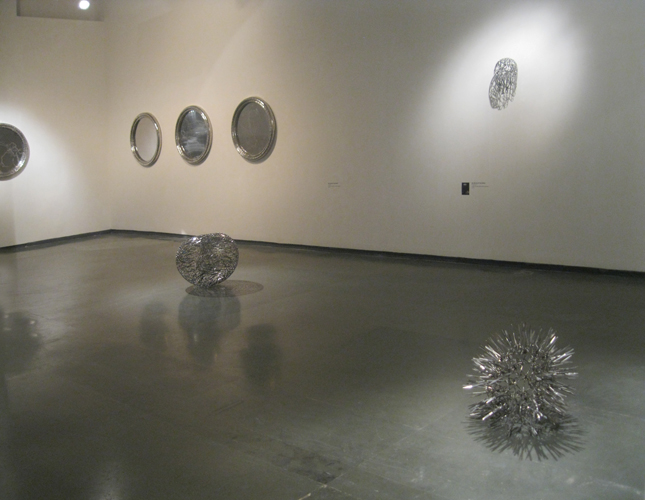
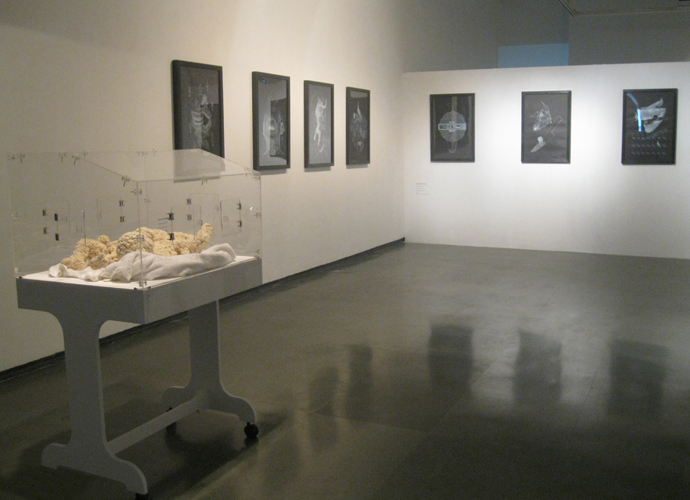
New York: Currently, the Guild Art Gallery in Mumbai is displaying an engaging group show entitled “Barbed Floss”. This exhibition consists of works by five artists from Bangladesh who have shown in a wide range of international institutions. “Barbed Floss” examines the concepts tied to cultural and literal barriers that cut through different parts of our contemporary world. Most specifically, the fifth largest border worldwide, the barbed wire fence separating Bangladesh and India.

Barbed Floss, Gallery View. The Guild

Barbed Floss, Gallery View. The Guild

The title “Barbed Floss” utilizes the literal and interpretive meanings of these two opposing terms. “Borders on land are made up of barbed wire fencing and high walls, extreme military security, extreme emotional insecurity. The word floss behaves as a thorough cleanser with a fine thread, which removes, cleanses and frees blockages”. Curated by Veeranganakumari Solanki this exhibition discusses the limitations, miscommunications and conflicts that come about in these neighbouring communities simply by the virtue of this physical divide.The Guild has chosen Tayeba Begum Lipi, Mahbubur Rahman, Promotesh Das Pulak, Molla Sagar and Anisuzzaman Sohel for this examination of cultural limitations. Each artist takes a unique approach to this subject matter. Some works reflect literal interpretations, others more theoretical and possible solutions for these issues. Personal, third person and political narratives can be seen through each individual work. This is their first time their work is being shown together in this format.

The Guild specializes in Indian Contemporary Art. Their programming stresses a commitment to artist/curator dialogue and encourages experimentation and conceptual creativity. The Guild was founded in 1997 as most recently has expanded its artist representation to international artists. “Barbed Floss” will run at the Guild Art Gallery through September 30, 2013.

For more information visit The Guild’s website.

My Picks from StoryLTD

Rashhi Parekh of Saffronart picks her five favourite pieces being offered for sale in the boutiques and collections on newly launched website, StoryLTD

Mumbai: Launched earlier this week, StoryLTD by Saffronart brings together carefully curated collections of beautiful and significant objects from the past and present. At StoryLTD, you can browse through, learn the nuances of, and acquire some of the most coveted objects – ranging from fine art, antiquities and jewellery, to vintage and designer furniture and unique accessories for the home.

Partnering with some of the most creative artists, designers, collectors, manufacturers and dealers from India and soon, around the globe, StoryLTD offers consumers a unified and convenient shopping experience for objects and collectibles encompassing all styles, designs and budgets.

Here are my five picks from the many beautiful objects available on the website. Not surprisingly, they are all art related!

Maqbool Fida Husain: Eternal Mother

Collection: Serigraphs

M.F. Husain

M.F. Husain, Eternal Mother, Serigraph on paper

The venerated figure of Mother Teresa first appeared in Maqbool Fida Hussain’s art in 1980. Since then he has devoted a number of his works to Mother Teresa, whom he depicts as a faceless entity. This approach underlines his efforts in exploring not just the figure of Mother Teresa, but motherhood in general.

Having had the opportunity to meet Mother Teresa in 1994, he says, “I have tried to capture in my paintings, what her presence meant to the destitute and dying, the light and hope she brought by mere inquiry, by putting her hand over a child abandoned in the street.. That is why I try it again and again, after a gap of time, in a different medium.”

Works like the ‘Eternal Mother’ have been converted into serigraphs by Husain, to make his art more widely accessible. He stated that the idea of creating prints from canvasses was to make his work available to common man and also make his inner psyche available to a larger audience. This painter is distinct and different from most others because he wants to share his paintings. He says that all his life, he has sought just one image – the image of his mother, whom he had never seen. He tried to depict his mother whenever he painted women; that is why he never painted their faces, merely just an outline as shown in this serigraph of the Eternal Mother.

Raja Ravi Varma: Sri Shanmukha Subramaniaswami

Collection: Dressed Oleographs

Raja Ravi Varma, Shri Shanmukha Subramaniaswamy

Raja Ravi Varma, Shri Shanmukha Subramaniaswamy, Dressed oleograph on paper

Considered one of the greatest painters in the history of Indian Art, Raja Ravi Varma was an artist who achieved recognition for his depiction of scenes from the epics of the Mahabharata and Ramayana. This oleograph like many of his other works, is a fusion of Indian traditions with the techniques of European academic art. His representation of mythological characters has become a part of the popular Indian imagination of the epics. Although his works are often showy and sentimental, they are very popular throughout India.

Here, Shanmukha or the six-faced Karthikeya, the elder son of Shiva and Parvati, is pictured on his peacock mount. Also known as Skanda, Subramania and Murugan, he is the God of War and Victory. Ravi Varma has depicted Shanmukha flanked by his two wives, Valli and Devasena, while the snake he is frequently associated with lies at their feet. The group is framed by the magnificent plumage of Shanmukha’s peacock, which symbolizes the deity’s victory over the ego.

Due to his vast contribution to Indian Art, in 1993 art critics curated a large exhibition of Raja Ravi Varma’s works at the National Museum in New Delhi.

Bhuri Bai: Speaking Tree

Collection: Gond Art

Bhuri Bai, Speaking Tree

Bhuri Bai, Speaking Tree, Acrylic on canvas

Bhuri Bai made her first mural painting at the age of ten. She was one of the very first women of her tribe to paint on paper and canvas. The forms depicted in her paintings appear to be in a state of weightlessness. The figures in this painting are made in bright colors, similar to paper cuts.

Many of the subjects in her painting depict the conflict between the woman, as a creator and the man, as a predator. These themes, which are often found in other early painters, may also be seen as metaphors for the theft of land, the relationship between man and animal, the domestic and the wild, the nature and the modern world. Her works share an ancestral view according to which every body is made out of particles.

Lado Bai: Sun and the Deer

Collection: Gond Art

Lado Bai, Sun and the Deer

Lado Bai, Sun and the Deer, Acrylic on canvas

Lado Bai started painting on canvasses at the same time as Bhuri Bai. Her main motifs are taken from the animal kingdom and Bhil rituals and festivals. Lado Bai’s art reflects “the flora and fauna of her environment along with rituals and festivals of her tribe. She draws Bhil Gods and Godesses in the centuries old Bhil style which is steeped in ethnic animism and spirituality.”

Today, this artist works at Adivasi Lok Kala Academy; however she was guided by artist Jagdish Swaminathan, who encouraged her to paint on canvasses instead of painting on mud walls in her village. Lado Bai has been able to make new statements through her art within the ambit of traditions, like other fresco painters of her generation.

Bose Krishnamachari: Stainless Steel Chandelier

Collection: Seven Art

Bose Krishnamachari, Stainless Steel Chandelier

Bose Krishnamachari, Stainless Steel Chandelier

Bose Krishnamachari’s stainless steel chandelier is an extremely unique piece of art. This chandelier can be viewed as an installation piece as well as a piece of furniture, because it has a unique combination of utility and design. The chandelier which appears to be the culmination of a number of individual lights put together haphazardly, is actually an extremely well designed object. It allows the viewer to depart from the perceived notion of a chandelier which is supposed to look elegant and somewhat symmetric. This chandelier is made with an extremely modern and contemporary outlook, almost as if it were the result of an experiment. According to some, it also looks like an asymmetrical space station.

This work by Bose Krishnamachari is abstract and dynamic. In all his works, weather it be paintings, photography or installations, these are dominant forces.