Blue Velvet: The Myth of the Kashmir Sapphires

Amy Lin of Saffronart explores the significance of the Kashmir sapphire in this month’s auction of Fine Jewels & Watches

Lot 25: AN UNMOUNTED NATURAL KASHMIR SAPPHIRE
A cushion-shaped modified brilliant and modified step cut sapphire, weighing 11.15 carats
Auction of Fine Jewels & Watches (OCT 30-31, 2012)

New York: At 11,000 feet above sea level, miners risk dangerous situations to procure one of the most precious gemstones in the world, the Kashmir sapphire. Kashmir sapphires retain a brilliant, dreamlike blue colour that captivated the hearts of kings and civilians alike. Some call these stones ‘blue velvet’, while others simply know them as the rarest sapphires in the world.

We are proud to feature a magnificent 11.15 carat Kashmir sapphire in this month’s auction of Fine Jewels & Watches. The gem is cushion shaped, with step cuts that illuminate its radiance. Its un-mounted nature allows designers and jewelry lovers countless ways in which to set it in a unique ring, brooch or pendant.

Sapphires are part of the mineral corundum family, and carry traces of aluminum oxide. Although they come in different colours, the most famous and sought after are blue sapphires that carry hints of titanium. Besides their brilliance, sapphires are extremely resilient, placing them second only to diamonds on the Mohs Hardness Scale. The value of sapphires is determined by their colour, purity, reflection and size.

The Maharaja of Jammu and Kashmir, late 19th century
Photographer: Deen Dayal
Image Credit: http://www.oldindianphotos.in/2012/02/maharaja-of-jammu-and-kashmir-late-19th.html

Sapphires were first discovered in Kashmir in the 1880s, when a landslide revealed a mineral deposit of exceptional quality and size. The British Indian geologist F.R. Mallet was hired to indentify the stones, which turned out to be sapphires like no other. He recorded his discovery in the Manual of Indian Geology at the Indian Museum. Upon hearing about the blue gems in his region, the Maharaja of Kashmir sent troops to secure the mines but allowed his subjects to keep the ones previously extracted. From 1882 to 1887, Kashmir flourished as riches spilled into the kingdom.

Before long, heavy mining led to the decline of profits and the depletion of resources.  Although evacuations have been led to find other mines, none could rival the quality of the first. In modern times, the Indian Himalayas have seen a lot of guerilla warfare. Therefore, whether additional deposits of Kashmir sapphires are still hidden underground is a matter of speculation. It is without a doubt that the sapphires from Kashmir’s early mining days are the best in the world in terms of their colour and size. Their unique, intertwining crystals give them a hazy, hypnotic quality that evokes dreams and mysticism. Because of their short mining debut, they are one of the rarest gems in the world, making them a true collector’s item.
More Silver for your Gold: Strong Demand for Indian Silver Abroad

Amy Lin of Saffronart reports on a likely 35% increase in silver exports from India in the coming year 

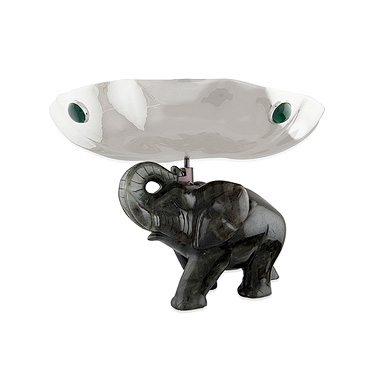
An ‘Elephant’ Dish
Created in 2012
Contemporary & Period Silverware Sale, Saffronart Delhi

Saffronart recently concluded its Exhibition of Contemporary & Period Silverware in Delhi. Some pieces are still available for purchase on the website.

Mumbai: In recent Dhanteras festivals, the most popular precious metal amongst consumers is not gold, but silver. Dhanteras is the first day of the Diwali celebrations on which buying precious metals is seen as an auspicious sign of wealth. P.S. Singhvi, a 50 year old businessman stood in line with more than a hundred people waiting to buy silver coins at Mumbai’s busy Zaveri Bazaar. He told The Financial Express, “We are interested in silver coins for mahurat (auspicious) trading. We can buy more silver for a lesser amount. For gold we will have to pay a high amount.” It seems that the potential value of silver is no longer a secret in India but has caught on with the rest of the world.

For three consecutive years, the demand for Indian silver continues to grow worldwide. This is due to skyrocketing gold prices, and the slowdown of manufacturing. Rajiv Jain, chairman of the Gems and Jewellery Export Promotion Council (GJEPC), estimated that the export for Indian silver will increase by 35% in the 2013 fiscal year.

Small-sized silver bars and coins dominated festival sales in India.
Image Credit: Reuters
http://www.financialexpress.com/news/silver-dominates-festival-sales-in-india/865147/5#

Already in 2011, an article from Bloomsburg News championed silver as the “common man’s gold.” Ketan Shroff, managing director of Pushpak Bullions Pvt. stated, “People are accumulating silver since gold is getting unaffordable to the common man.” Consequently, the common man’s demand has a strong reflection on the world market. From 2011-12, silver exported from India increased to 44% while gold exports remained at 30%. There are a lot of investments to be made in silver as an average overseas consumer can purchase quality silver pieces for less than $100 (Rs. 5,200).

In response, the import of silver to India has also increased as a response to demand. Prithviraj Kothari, president of the Bombay Bullion Association, stated in The Wall Street Journal last February that “India’s silver imports may top 5,000 metric tons in 2012 due to strong investment demand” compared to the 4,800 metric tons in 2011.

Shroff enthusiastically stated in India Times, “The trend is fast picking up. Investors and jewellery lovers prefer more of silver jewellery as gold prices go up consistently. If the positive sentiments can keep up the pace, silver prices may go over Rs 1 lakh, beating last year’s Rs 75,000 levels.”  With such prospects, silver may no longer be the common man’s gold but a precious metal just as valuable if not more.

A Tea and Coffee Set
Contemporary & Period Silverware Sale, Saffronart Delhi

My Introduction to Art Deco

Medha Kapur of Saffronart responds to some of the lots coming up in our Art Deco Auction

Mumbai: It seems these days that all sorts of old styles are coming back into fashion! The design style known as Art Deco began in Paris in the 1920s, and has made several comebacks since. These days Art Deco fashion, jewelry, and even furniture are all the subject of new trends. Working at Saffronart, I have met some very creative individuals and major fans of the Art Deco period.

Deco is a strong, beautiful style. Its typical attributes include geometric shapes, bold curves, strong lines, aerodynamic forms, and sunbursts galore. A distinct departure from previous design styles, Deco evoked elegance and modernity. It was also influenced by the increased ability to travel, inspired not only by modernism, but by the cultures of faraway places such as Egypt, China and Japan.

Saffronart is holding its inaugural Art Deco auction on October 31-November 1, 2012. The idea is to showcase the Art-Deco style, which defined South Bombay in the 1920s and 30s, and is now synonymous with its unique heritage. This auction will also help raise awareness and funds for Mumbai’s bid to nominate its Art-Deco and Victorian precincts as a UNESCO World Heritage Site. Saffronart and its consignors have committed to donating 5% of the proceeds from the sale of select lots to this cause.

The auction will feature original furniture, timepieces, accessories and jewelry. I was completely floored by one of the furniture pieces in the sale, a rare lady’s vanity. What grabbed my attention was the story behind it! The piece is likely to have belonged to a distinguished Indian lady, and was probably used as a travelling dresser during long cruise-liner voyages to Europe, extended stays at summer homes in the hills, and in luxury tents during the ‘shikar’ or hunting season. Sounds quite majestic!

lady’s vanity case

lady’s vanity case

Another evocative and glamorous piece in this auction is a custom-designed bracelet watch in 18 K gold with diamond accents. This watch was made for the Princess of Jodhpur, and included as a part of the Indian traditional dowry system when she got married to the Yuvraj of Baroda. The splendid provenance of this fine wristwatch makes it a coveted acquisition, as the royal house of Baroda is synonymous with style and refinement.

Wristwatch from the estate of the late Maharani Padmavati Devi Gaekwar of Baroda.

Universal Geneve wristwatch from the estate of the late Maharani Padmavati Devi Gaekwar of Baroda.

Despite having a very specific look and feel, Art Deco objects seem to have a modernism about them that makes their appeal quite timeless. There are certain styles that will never go out of fashion, and I believe Art Deco is one them!

Indo-Deco and Viren Bhagat: A Brief Look at Art Deco in Indian Design

Amy Lin of Saffronart explores one of the facets of the role Art Deco continues to play in Indian design

New York: Contemporary jewelry designer Viren Bhagat draws on India’s past in his work and fuses Art Deco with traditional Indian designs. Recently the subject of an in-depth Vanity Fair profile, and featured in prestigious boutiques like F.D. or Fiona Druckenmiller in Manhattan, Bhagat’s pieces combine various design influences, including the clean lines of Art Deco and the dramatic flair of Mughal motifs. This enchanting diamond, ruby and natural pearl brooch for example, beautifully combines immaculate diagonals and flat diamonds with floral arabesques and a teardrop tassel.

Diamond, Ruby and Natural Pearl Brooch by Viren Bhagat
Image Credit: http://wwww.worldwatchweb.com/Picture-459-6-BROOCHES.html

In a New York Times interview, Drunkenmiller describes Mr. Bhagat’s works as “sumptuous, elegant, (and) romantic…He only uses the best stones, drawing inspiration from traditional Mogul design, but adding touches that are contemporary and uniquely his own.” But where does the idea for Bhagat’s hybrid come from?

Bharatiya Vidya Bhavan building, a fine example of the Deco-Saracenic style in Mumbai.
Image Credit: http://www.frontlineonnet.com/fl2608/stories/20090424260806600.htm

As it turns out, Art Deco is an important component of India’s artistic heritage. Following Miami, Mumbai has the greatest number of Art Deco buildings in the world, located in not one, but two distinct Deco precincts. The style called Deco-Saracenic, which fuses Art Deco with Hindu and Islamic aesthetics, is unique to India. Strong, sleek lines are interwoven with sensuous curves in both architecture and the decorative arts. The Bharatiya Vidya Bhavan building is a fine example of the Deco-Saracenic style, where geometric exteriors are rounded off with stylized domes. Such Deco trends in Mumbai came shortly after the First World War, when elegance and modernity became driving forces in Indian society.

A Natural Pearl and Diamond Ring, by Viren Bhagat
Image Credit: http://pinterest.com/pin/36028865739238093/

Viren Bhagat gives the idea of Deco-Saracenic a contemporary twist by applying it tojewelry. Bhagat’s one of kind ring, pictured below, dons a whimsical Mughal crown and springs to a life of its own, recalling past glories. Another pair of floral earrings, also pictured below, combines geometric shapes with ingenuity, using un-faceted diamonds.

In the coming weeks, Saffronart will also celebrate India’s jewelry and Art Deco heritages through its annual Autumn Auction of Fine Jewels and Watches and its inaugural Art Deco auction featuring furniture, silver, crystal, lighting and more.

Caring for Your Silver

Medha Kapur of Saffronart shares some details on how to care for your silverware

Mumbai: I adore the ultra glamorous look of a white living room with gleaming sterling silverware! I think the combination of the two is forever chic! I do, however, realize that sometimes this just isn’t practical…but all that silver needs, is to be taken care of properly! Here are a few tips on how to look after your silver:

Touch your silver pieces as little as possible as fingerprints accelerate tarnishing. All silver exposed to air will tarnish over time. It can also be tarnished by certain foodstuffs, including vinegar, eggs, etc. Silver is a soft metal which can be dented or damaged when handled roughly. Silver abrades easily and should not come in contact with other materials.

Here are a few things you could do at home to clean your silver:

Swab surface with methylated or white spirit to remove grease and dirt – some tarnish may also be removed. Use this method when you see the surface of your silver objects looking dull or yellowish.

If tarnish remains, try gently rubbing a silver cloth over the surface – this has mild abrasive particles embedded in it. To get into small corners with the silver cloth, cut out a small square, make a cotton wool swab, wrap the silver cloth round the swab and use the swab to push the silver cloth into the small areas.

Wipe with a clean silver cloth

Wipe with a clean silver cloth

You can also try a mild abrasive paste, cream or foam. Rub gently over the tarnished area in a circular motion. Remove silver foam residues with a swab moistened with distilled water.

Heavy tarnished silver (decorated surfaces) may need to be cleaned with a silver dip.

Silver foam contains very fine abrasives, mild soap and
chemicals that help remove tarnish.

Read more