Arpita Singh’s Men in Turmoil

Guest Blogger, Bansie Vasvani on Arpita Singh’s solo show at the DC Moore Gallery, New York (on view until January 5, 2013)

Installation Shot, DC Moore Gallery, New York
Courtesy of DC Moore Gallery, New York

New York: Arpita Singh’s vibrant watercolor works on paper, currently on view at the DC Moore Gallery in New York, are a departure from her signature portrayal of women. Here men take center stage, often in an uneasy stance, caught in the crossfire of urban chaos and unease. Singh subverts the conventional heroic male by depicting a slew of men plagued by the overbearing metropolis filled with snaking highways and packed motorcades that bombard the human mind with too much noise and pollution.

Arpita Singh, Cain (?) the Wanderer, 2012
Watercolor on paper, 16 x 11 1/2 in.
Courtesy of Vadehra Art Gallery, New Delhi and DC Moore Gallery, New York

In Cain (?) The Wanderer, 2012, a lone figure in threadbare Gandhian garb traverses the urban landscape. Much like his biblical counterpart, who is shamed for killing his brother and compelled to be a wanderer, Singh’s wanderer too is bereft and alone. Yet the simplicity of his appearance makes us question whether in fact he is truly ill-equipped for the modern world or if his bare upper body, stripped of cover and pretention, attains a mysterious alchemy of strength to face the world. The text inscribed on his body and the surrounding environment alludes to Singh’s cryptic, deeply personal worldview, often difficult to decipher. Is her wanderer a ruthless modern day Cain, or is his Gandhian facade emblematic of forthcoming quietude? Multi-layered and symbolic, Arpita Singh’s work is a complex configuration inundated with allusions to mythology, popular culture and current events.

Arpita Singh, The Kingsway, 2004
Watercolor on paper, 17 3/4 x 23 3/4 in.
Courtesy of Vadehra Art Gallery, New Delhi and DC Moore Gallery, New York

Informed by the tradition of miniature painting, textiles and folk art, The Kingsway, 2004,
presents a grid like structure on which five perturbed men stand and look askance at their
surroundings. Clothed in simple cotton ware, these male figures hold pistols close to their
phalluses implying a sense of impotence in their roles as guardians of their environment. The grid like formation, and the text in the densely populated cityscape that form the background of this painting, become important signifiers of a dangerous world fraught with tension. Singh’s men are caught in a current of urban disquiet where their internal psychic condition is reflected in the jarring quality of the external space thereby blurring the boundaries between internal and external, public and private, conscious and unconscious. The inner space of their minds cannot be separated from the external din and danger of the streets and highways. Her male figures appear weak and vulnerable in the face of an outside threat, making a mockery of their manhood. But like the protagonist of the previous work, we are left to wonder if their simplicity points to ineptitude in a complex world, or a blessing in disguise.

Arpita Singh, Untitled, 2010
Watercolor on paper, 14 1/2 x 11 in.
Courtesy of Vadehra Art Gallery, New Delhi and DC Moore Gallery, New York

In Untitled, 2010, and The Roadmap Creeps in the Page of my Notebook, 2012, the flat grid like structure appears as a leitmotif against which Singh places her figures, numbers, and words. Inspired by a label from a tea carton, the flat surface was conducive to her meticulous art making process of layering colors that resemble thick pastel, such that her watercolors appear saturated with pigment and tone. Through these rich tapestries dense with imagination and experience, Singh depicts a world steeped in anxiety with a sliver of hope towards a future of some peace and resolution.

Arpita Singh, The Roadmap Creeps in the Page of My Notebook, 2012
Watercolor on paper, 16 x 11 15/8 in.
Courtesy of Vadehra Art Gallery, New Delhi and DC Moore Gallery, New York

Bansie Vasvani is an independent art critic based in New York City.  She has a Masters Degree in Modern and Contemporary Art, and has traveled extensively to art fairs all over the world.

Gangnam for Freedom – Anish Kapoor and Friends (Official Video)

Nishad Avari of Saffronart on the release of Anish Kapoor’s take on ‘Gangnam Style’

Mumbai: A few days ago, we posted about the highly anticipated release of Anish Kapoor’s music video supporting the freedom of expression in general, and Chinese contemporary artist, Ai Weiwei in particular. Well, the video is finally out!

So here’s Kapoor and several of his high profile friends in the parody video, Gangnam for Freedom, hot off the press. Or should we say edit suite? Don’t miss cameos by museum staff from the Guggenheim, MoMA , Hirschorn, LACMA, Whitney, Serpentine and more!

Antique Writing Boxes

In conjunction with the uniquely crafted Indian and Chinese boxes featured in The Story by Saffronart, Medha Kapur shares a note on Antique Writing Boxes or Lap Desks 

An Organizer Table
The Story by Saffronart

Mumbai: Writing boxes or lap desks have existed for many centuries and in many cultures. More of a personal possession than the writing desk or table, these were mainly used by men and were also a symbol of social status. Essentially, writing boxes were small enough to be carried anywhere and often traveled with the owner. Antique lap desks had hinged writing surfaces, often covered in leather or felt, that flipped up to reveal storage space for papers. Individual compartments were designed to hold inkwells, pens, sealing wax, and other writing implements. Some desks also had concealed storage compartments.

From the late 1700s, writing boxes were frequently used in military expeditions and travels, besides libraries and drawing rooms. Several famous pieces of literature, contracts, letters and postcards have been penned on them. These boxes were hugely popular among army officers, who used them to write letters to their loved ones, as well as for business.

In the middle of the 18th century, with industrialization, land reforms, new mechanical inventions and expanding overseas trade coming into play, there was a need for goods to be transported. This led to a boom in personal travel as well. Portable writing boxes became obligatory for more people as they transacted, traveled or wrote letters from home. Education was revived on many levels of society to cope with the new needs. These boxes were an item that connected with intellectuals; however, the style, quality, ornament and form of the desk also played an important role.

Thomas Jefferson's Desk-1776

Thomas Jefferson’s Desk-1776

Thomas Jefferson conceptualized a design for a small lap desk that could be taken anywhere. This desk, one of numerous inventions Jefferson devised for his own convenience, was designed in May 1776 and built by Benjamin Randolph, a Philadelphia cabinetmaker and prominent patriot. Randolph built the desk for Jefferson based on his plans, using solid mahogany with inlays at both ends. Though small, the desk must have proved a very difficult project, with lots of fine, delicate details to be taken into account. The desk, being small and portable, provided the perfect companion to Jefferson during his travels, allowing him the comfort of reading and writing wherever he roamed. Many of Jefferson’s letters, memos and papers were composed on the desk, and it was also used in the drafting of the Declaration of Independence. Jefferson carried the desk with him until the year he died – at which point it was passed on to his grandson-in-law, Joseph Coolidge.

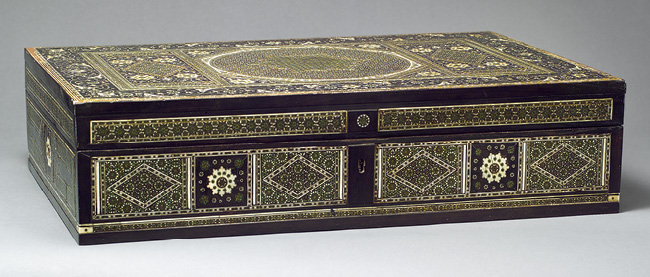
Another interesting writing box from the permanent collection of the Metropolitan Museum of Art in New York is a late 16th or early 17th century example from India, probably Gujarat or Sindh. This box consists of sections made from diverse materials including tin, wood, ivory and bone.

Writing box from the Metropolitan Museum of Art

Writing box from the Metropolitan Museum of Art

Similar to these pieces is the unique Munim Chest or money lender’s box, part of the collections Boxed on The Story by Saffronart.

Munim Chest

Munim Chest
The Story by Saffronart

Munim Chest

Munim Chest
The Story by Saffronart

Mapping India: The Changing Perspectives of India in the Eyes of 16th century Europeans

Amy Lin of Saffronart offers a brief account of the history of India through European cartography

Sebastian Münster, Tabula Asiæ X’. Basel: Henricus Petri, 1545. Third Münster edition. Woodcut

New York: Until the modern ages, Europeans viewed India with a mix of enchantment and exoticism. This fascination is evident in the maps drafted by European explorers and scholars, among other documents. From antiquity to the Renaissance, the main source for Indian geographic information came from the Hellenistic cartographer Ptolemy’s Geographia. During the 15th century, the dawn of exploration coincided with the invention of printmaking, and revolutionized methods in cartography.

Laurentius Frisius,‘Tabula Asiæ X’. Strassburg: Joannes Gruninger, 1525. Woodcut

The magnificent maps of India included in the collection Imagining India on The Story by Saffronart date from 1525-1619. These documents chart changing European perspectives on the subcontinent – from a strange, misshapen land to a valuable center of trade for the West. Originally, there were 1,000 copies of most of these maps, but the majority did not survive over the centuries. Half science and half myth, these beautiful artifacts are both art objects and historical resources. For half a millennium, they represented India as a realm of the exotic, ever since Alexander the Great’s campaign first reached the peninsula in the 2ndA.D.

The earliest accounts of Indian geography were crude and rudimentary at best. Ptolemy poured over manuscripts at the Library of Alexanderia and complied the eight volume Geographia without setting foot in India. Well into the 16th century, scholars and mapmakers still relied on Ptolemy’s drafts for printing atlases. The German cartographer Sebastian Munster (1488-1552), featured in the collection on The Story, published editions of the Geographia where India’s southern peninsula was nonexistent. This reflected the fact that Alexander’s armies did not venture beyond Northern India, and the South remained unfamiliar to them.

Vasco de Gama leaves for India in 1497
Image Credit: http://thebilyards.wordpress.com/page/4/

The Age of Discovery brought Vasco de Gama to India in 1497. Soon, the European concept of ‘India within the Ganges’ began to broaden and a realistic image of the Indian landmass began to circulate among scholars. Jacobo Gastaldi (1500-1566), a Venetian cartographer featured in the collection on The Story, was among the first to bring a modern image of India to Europe. His engravings show for the first time the considerable length of India’s peninsula. Gastaldi also pioneered other pinnacle developments such as pocket size atlases and the use of copper engravings in mapmaking instead of traditional woodcuts to bring out greater detail and finesse.

The maps in the collection on The Story are more telling than one presumes. By simply surviving through the centuries, they give a chronological account on how Indian geography changes in the eyes of Europeans though discovery, science and innovation. Nevertheless, what remains at the core are beautifully executed engravings that showcase the skill of a craftsman and the imagination of an artist.

Giacomo Gastaldi, ‘Calecut Nuova Tavola’. Venice: Vicenzo Valgrisi, 1562. First Latin edition of Gastaldi

Spot on! Damien Hirst’s spot paintings exhibited worldwide

In conjunction with the the Damien Hirst spot print featured on The Story by Saffronart, Elisabetta Marabotto revisits the artist’s global exhibition, ‘The Complete Spot Paintings (1986-2011)’

Damien Hirst, Isonicotinic Acid Ethyl Ester, 2010–11.

Damien Hirst, Isonicotinic Acid Ethyl Ester, 2010–11.
Image Credit: http://www.gagosian.com/exhibitions/damien-hirst–january-12-2012-9/exhibition-images

London: For the few people who may not be familiar with Damien Hirst’s works, they can be categorized in three broad groups: colourful spots, medicine cabinets, and animals preserved in formaldehyde. However, the spot paintings are perhaps the most predominant element of his body of work, and definitely my favourite one.

Since the 1980s, the artist has been investigating the complex relationship between life, death and art using different media. He is one of the main figures of the collective known as the Young British Artists, who led the British art scene in the 1990s. Over the years, Hirst achieved international fame and success, and at one point was known as the world’s richest living artist. His works have always been quite controversial, but this is perhaps one of the reasons for his popularity and celebrity.

Damien Hirst, Installation view at Gagosian Gallery, London.

Damien Hirst, Installation view at Gagosian Gallery, London.
http://www.gagosian.com/exhibitions/damien-hirst–january-12-2012-2/exhibition-images

At the beginning of 2012, in conjunction with Larry Gagosian, Hirst planned to exhibit his spot paintings at Gagosian Gallery’s locations all over the world. So from January to March, every Gagosian Gallery was surrendered to the artist’s spot works. From New York and Los Angeles to London, Rome, Athens, Hong Kong, Paris and Geneva more than 300 paintings by Hirst were exhibited in Gagosian’s spaces.

Most of the works were lent by private collectors or public institutions, which made the exhibitions quite different depending on the location. For example, the round canvases were very popular in America, while the irregularly-shaped ones received great success in Europe and especially London.

Damien Hirst, Zirconyl Chloride, 2008.

Damien Hirst, Zirconyl Chloride, 2008.
Image Credit: http://www.gagosian.com/exhibitions/damien-hirst/exhibition-images

Among the many works on display were the first ever spot painting made by Hirst in 1986, the smallest spot painting measuring 1 x ½ inches, the largest spot painting depicting four spots each measuring 60 inches in diameter and the most recent one, dated 2011, comprising 25,781 spots! In the last, each of the spots measures 1 millimeter in diameter, and no colour has been used more than once.

Speaking about his spot paintings, Hirst noted: “I was always a colorist, I’ve always had a phenomenal love of color… I mean, I just move color around on its own. So that’s where the spot paintings came from—to create that structure to do those colors, and do nothing. I suddenly got what I wanted. It was just a way of pinning down the joy of color.”

From Damien Hirst, to Yayoi Kusama and Bharti Kher (allowing myself to compare bindis to colourfully painted dots) the spot seems to be firmly entrenched in the world of contemporary art and fashion. So why not take advantage of the Hirst spot print on sale at The Story by Saffronart and become part of this trend?

More information on Damien Hirst’s “The Complete Spot Paintings” can be found on the Gagosian Gallery website and on Hirst’s website.

A large retrospective of this celebrated artist was organized by the Tate Modern, London earlier this year. Read more.