More Silver for your Gold: Strong Demand for Indian Silver Abroad

Amy Lin of Saffronart reports on a likely 35% increase in silver exports from India in the coming year 

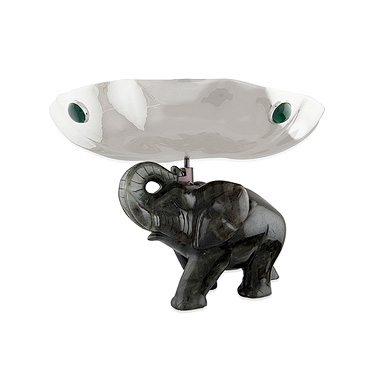
An ‘Elephant’ Dish
Created in 2012
Contemporary & Period Silverware Sale, Saffronart Delhi

Saffronart recently concluded its Exhibition of Contemporary & Period Silverware in Delhi. Some pieces are still available for purchase on the website.

Mumbai: In recent Dhanteras festivals, the most popular precious metal amongst consumers is not gold, but silver. Dhanteras is the first day of the Diwali celebrations on which buying precious metals is seen as an auspicious sign of wealth. P.S. Singhvi, a 50 year old businessman stood in line with more than a hundred people waiting to buy silver coins at Mumbai’s busy Zaveri Bazaar. He told The Financial Express, “We are interested in silver coins for mahurat (auspicious) trading. We can buy more silver for a lesser amount. For gold we will have to pay a high amount.” It seems that the potential value of silver is no longer a secret in India but has caught on with the rest of the world.

For three consecutive years, the demand for Indian silver continues to grow worldwide. This is due to skyrocketing gold prices, and the slowdown of manufacturing. Rajiv Jain, chairman of the Gems and Jewellery Export Promotion Council (GJEPC), estimated that the export for Indian silver will increase by 35% in the 2013 fiscal year.

Small-sized silver bars and coins dominated festival sales in India.
Image Credit: Reuters
http://www.financialexpress.com/news/silver-dominates-festival-sales-in-india/865147/5#

Already in 2011, an article from Bloomsburg News championed silver as the “common man’s gold.” Ketan Shroff, managing director of Pushpak Bullions Pvt. stated, “People are accumulating silver since gold is getting unaffordable to the common man.” Consequently, the common man’s demand has a strong reflection on the world market. From 2011-12, silver exported from India increased to 44% while gold exports remained at 30%. There are a lot of investments to be made in silver as an average overseas consumer can purchase quality silver pieces for less than $100 (Rs. 5,200).

In response, the import of silver to India has also increased as a response to demand. Prithviraj Kothari, president of the Bombay Bullion Association, stated in The Wall Street Journal last February that “India’s silver imports may top 5,000 metric tons in 2012 due to strong investment demand” compared to the 4,800 metric tons in 2011.

Shroff enthusiastically stated in India Times, “The trend is fast picking up. Investors and jewellery lovers prefer more of silver jewellery as gold prices go up consistently. If the positive sentiments can keep up the pace, silver prices may go over Rs 1 lakh, beating last year’s Rs 75,000 levels.”  With such prospects, silver may no longer be the common man’s gold but a precious metal just as valuable if not more.

A Tea and Coffee Set
Contemporary & Period Silverware Sale, Saffronart Delhi

An Introduction to Kashmiri Art and Craft

Sneha Sikand of Saffronart explores some of the the arts and crafts of Kashmir featured in The Story by Saffronart

New Delhi: Kashmir is considered to be a treasure trove of arts and crafts. While every region tends to have its own distinct specialty, Kashmiri carpets, shawls, papier-mâché objects and silverware are recognized worldwide for their fine quality and craftsmanship.

A Bakhtiari Carpet
Image credit: http://www.saffronart.com

Carpet weaving is not indigenous to Kashmir and is thought to have been introduced there by Persian settlers. These settlers brought with them the knowledge of patterns and designs distinct to their communities, which is why many Kashmiri carpets carry motifs that are distinctly Persian, with some local variations. The Bakhtiari design, also known as the ‘paneled-garden design’ is named after a region in Iran called Bakhtiar. The field of the Bakhtiari carpet is divided into compartments or panels, containing individual motifs or patterns. Often a set of 3-4 compartments is repeated throughout the field. While the design may have originated in Bakhtiar, it is an often identified design in Kashmiri carpets.

A Paisley woven wool and silk shawl with typical all over design, circa 1860
Image credit: http://www.meg-andrews.com

The paisley design is said to have got its name from the shawl manufacturing town, Paisley in England. Also known as the Boteh or pine motif, it is believed that it first used in Kashmir during the seventeenth century.

Paisley motif development
Image credit: http://www.meg-andrews.com

The pattern can be traced back to ancient Babylon, where a tear-drop shape was used as a symbol to represent the growing shoot of a date palm. The palm provided food, drink, clothing (woven fibres) and shelter, and so became regarded as the ‘Tree of Life’. Other theories state that the motif is a stylized depiction of a mango, a fruit commonly found in India. Shawls from Kashmir have always been the most sought after for being woven from hair, and being lighter and smooth with a natural sheen.

Silverware and papier-mâché are two other equally popular items that Kashmir is known for. Local silversmiths incorporated the Chinar-leaf design into silver objects. Called booune in Kashmiri, the chinar tree came to Kashmir in the sixteenth century when Emperor Akbar arranged for the planting of several hundreds near the Hazratbal shrine. It is said that when the leaves on the trees turned red, the emperor saw them from a distance and exclaimed, “Chin-nar!” which means blazing colour.

Sugar bowl with Chinar Decoration, circa. 1890
Image credit: http://www.silverfromindia1850-1920.blogspot.in

Papier-mâché was also introduced to Kashmiri craftsmen by Persian settlers. Initially used to make boxes to transport expensive shawls to Europe, Kashmiri papier-mâché was so loved in countries such as France, that it started selling on its own. Today, it has become highly stylized with the use of real gold and silver paint, and by adding intricate decorations. The designs and decorations still have a strong Persian influence. Some items like bowls and vases are lined with brass, while some exquisitely carved items are ornamented with gold and silver leaf and depict beautiful landscapes and objects like house boats, that are an integral part of Kashmiri life.

The Metropolitan Museum of Art: Galleries for the Art of the Arab Lands, Turkey, Iran, Central Asia, and Later South Asia – Part V

Josheen Oberoi of Saffronart explores the stunning new galleries of Islamic art at the Met, a few centuries at a time.

New York: This is the last in a series of posts that came out of my visit to the Islamic Art collection at the Metropolitan Museum of Art in New York and a consequent conversation with Dr. Maryam Ekhtiar, an Associate Curator in the Department of Islamic Art there.  This art collection is presented in fifteen new galleries that opened to the public after an eight year renovation in November last year.

The galleries are titled Art of the Arab Lands, Turkey, Iran, Central Asia, and Later South Asia. Dr. Ekhtiar, in speaking of the nomenclature of the collections, said, “the name of the galleries speaks to the parameters of our collection, our department’s collection”.  Instead of the overarching phrase “Islamic Art” that suggests a monolithic construction of an Islamic culture; this title is in fact a clue to the physical and historical reconfiguration of these galleries, and a particularly apt one in these times of misleading narratives of Islam worldwide.

Through the course of my conversation with Dr. Ekhtiar we walked chronologically through the numbered galleries (Galleries 450 – 464) that are organized by geographical regions and time periods (from ca. 7th century AD through ca. 20th century). I have followed the same chronology here, bringing us today to the last two galleries 463 and 464 showing Mughal and later South Asian art.

Here’s the very useful museum map again, to help follow the information:

Floor Plan of New Galleries
Image courtesy: The Metropolitan Museum of Art

We haven’t discussed South Asia previously but the time period (16th – 20th centuries) that we will look at today is contemporary to the arts of Safavids and later Iran and the overlap and exchange of culture is visible in the artistic forms of the time as well. Gallery 463, for example, presents the arts of the Sultanate, Mughal and Deccan courts from about 1450 through the nineteenth century. This gallery contains an extensive selection of jeweled arts that were practiced in South Asia, including jade carving (which was highly prized in China and was part of a commercial exchange with it). But like in Gallery 462, the two object forms that immediately capture attention are the carpets and the illustrated manuscripts’ folios.

Carpet with Scrolling Vines and Blossoms
Object Name: Carpet
Date: ca. 1650
Geography: Northern India or Pakistan, Kashmir or Lahore
Image courtesy: The Metropolitan Museum of Art

The scrolling vegetal designs that we saw in last week’s post are visible in the image on the left as well. The carpet below, on the other hand, with a niche that nestles a flowering plant, appears to be designed vertically and possibly for hanging on the wall rather than laying on the ground.

Carpet with Niche and Flower Design
Object Name: Carpet
Date: mid-17th century
Geography: India or Pakistan, Kashmir or Lahore
Image courtesy: The Metropolitan Museum of Art

Interestingly, these styles remained active in the Iranian and South Asian regions. The early 20th century example below, from a Saffronart auction in March this year displays a combination of these design details – the visible Arabesque niche in the carpet is occupied by intricate and delicate flora and fauna, surrounded by a border.

“Akbar Hunting with Cheetahs”, Folio from an Akbarnama
Painting attributed to Manohar (active ca. 1582–1624)
Object Name: Illustrated album leaf
Date: ca. 1604
Geography: India
Image courtesy: The Metropolitan Museum of Art

Illustrated manuscripts, similarly, remained an active part of the region through the 20th century as indicated by the folios on display in this gallery and in Gallery 464. Akbar, considered the greatest Mughal rulers (r. 1556 – 1605), established royal ateliers and commissioned illustrated manuscripts, including the Akbarnama that was a chronicle of his reign.

His successors Jahangir (r. 1605-27) and Shah Jahan (r. 1628-58) continued this patronage,an example of which is the exquisite Padshahnama, or the Shah Jahan Album illustrated through the 1640s. These reigns saw a diversity of manuscript production that included Indian, Persian and European elements (like linear perspective and European motifs). A few of the folios shown below evidence this multitude of subjects like studies of animals, flora and fauna, portraiture,mythological narratives that were produced simultaneously at that time. It also underlines the development of a unique idiom within the South Asian region in the arts of the book both linking it to and distinguishing it from the Safavid and later Iran workshops.

“Rama Receives Sugriva and Jambavat, the Monkey and Bear Kings”, Folio from a Ramayana
Object Name: Folio from an illustrated manuscript
Reign: Akbar (1556–1605)
Date: ca. 1605
Geography: India
Image courtesy: The Metropolitan Museum of Art

Madonna and Child in a Domestic Interior
Painting by Manohar (active ca. 1582–1624)
Object Name: Illustrated single work
Date: early 17th century
Geography: India
Image courtesy: The Metropolitan Museum of Art

“Shah Jahan on a Terrace, Holding a Pendant Set With His Portrait”, Folio from the Shah Jahan Album
Painting by Chitarman (active ca. 1627–70)
Object Name: Album leaf
Reign: Shah Jahan (1628–58)
Date: recto: 1627–28; verso: ca. 1530–50
Geography: India
Image courtesy: The Metropolitan Museum of Art

“Black Buck”, Folio from the Shah Jahan Album
Painting attributed to Manohar (active ca. 1582–1624)
Object Name: Album leaf
Reign: Jahangir (1605–27), recto
Date: recto: ca. 1615-20; verso: ca. 1530–50
Geography: India
Image courtesy: The Metropolitan Museum of Art

Adventures of Hamza or the Hamzanama was another narrative commissioned by Akbar that recounted the stories of Hamza, an uncle of Prophet Mohammad.

“Misbah the Grocer Brings the Spy Parran to his House”, Folio from a Hamzanama (The Adventures of Hamza)
Attributed to Dasavanta
Artist: Attributed to Mithra
Object Name: Folio from an illustrated manuscript
Reign: Akbar (1556–1605)
Date: ca. 1570
Geography: India
Image courtesy: The Metropolitan Museum of Art

Both Galleries 463 and 464 also have folios from the Islamic Deccan courts and later 19th century court arts of the Jain, Rajput, Pahari and “Company” style paintings. These are placed in conjunction with the Islamic art galleries to  accurately represent the continuum of South Asian art, not compartmentalized by religion. There was a rich dialog between the two contemporaneous traditions that is visible throughout these galleries.

For example, the image below on the left, of a nobleman on a terrace is an 18th century folio from a late Islamic Mughal center in Bengal, and on display in these galleries. The image on the right, from a Saffronart auction in April this year is the portrait of a Hindu Bikaneri maharaja. Such cross currents in portraiture, amongst other subjects, is a constant in these artistic traditions.

Portrait of a Maharaja
Late 17th Century
Bikaner School

Nobleman on a Terrace
Object Name: Illustrated single work
Date: ca. 1780
Geography: India, Murshidabad
Image courtesy: The Metropolitan Museum of Art

Ragamala paintings, also available for viewing, are a pictorial narrative mode for musical notes (ragas) that originated in the Islamic Deccan kingdoms but found their way to the ateliers of princely states in Rajasthan.

And finally, the “Company” school paintings, shown in Gallery 464 often documented the flora, fauna, topography and people of the land. These watercolors were commissioned by the British and executed by Indian painters in a European style.

Chronologically the last space in the newly configured galleries that we have been visiting over the last few posts, Gallery 464 can also be physically entered and understood independent of the remaining galleries.However, that is true of any of the fifteen galleries. Choosing your personal path through these spaces engenders a distinct experience each time.

Text (calligraphy), shapes (geometric, vegetal, figural, flora, fauna, zoomorphic), materials (ceramic, wood, metals, paper, textile), techniques (luster-painted, gilded, enameled, painted, carved), objects (utilitarian, luxurious,  decorative, religious) – these are just a few of the forms that can be conceptually and visually followed through these galleries. Recurring, in various ways, in various objects, they tell a story of a cultural continuum, not an overarching structure – this is a testament to the impeccably curated experience of these new galleries.

I hope you’ve enjoyed this ride with me. The Saffronart blog hopes to keep taking you along for more of these!
My Introduction to Art Deco

Medha Kapur of Saffronart responds to some of the lots coming up in our Art Deco Auction

Mumbai: It seems these days that all sorts of old styles are coming back into fashion! The design style known as Art Deco began in Paris in the 1920s, and has made several comebacks since. These days Art Deco fashion, jewelry, and even furniture are all the subject of new trends. Working at Saffronart, I have met some very creative individuals and major fans of the Art Deco period.

Deco is a strong, beautiful style. Its typical attributes include geometric shapes, bold curves, strong lines, aerodynamic forms, and sunbursts galore. A distinct departure from previous design styles, Deco evoked elegance and modernity. It was also influenced by the increased ability to travel, inspired not only by modernism, but by the cultures of faraway places such as Egypt, China and Japan.

Saffronart is holding its inaugural Art Deco auction on October 31-November 1, 2012. The idea is to showcase the Art-Deco style, which defined South Bombay in the 1920s and 30s, and is now synonymous with its unique heritage. This auction will also help raise awareness and funds for Mumbai’s bid to nominate its Art-Deco and Victorian precincts as a UNESCO World Heritage Site. Saffronart and its consignors have committed to donating 5% of the proceeds from the sale of select lots to this cause.

The auction will feature original furniture, timepieces, accessories and jewelry. I was completely floored by one of the furniture pieces in the sale, a rare lady’s vanity. What grabbed my attention was the story behind it! The piece is likely to have belonged to a distinguished Indian lady, and was probably used as a travelling dresser during long cruise-liner voyages to Europe, extended stays at summer homes in the hills, and in luxury tents during the ‘shikar’ or hunting season. Sounds quite majestic!

lady’s vanity case

lady’s vanity case

Another evocative and glamorous piece in this auction is a custom-designed bracelet watch in 18 K gold with diamond accents. This watch was made for the Princess of Jodhpur, and included as a part of the Indian traditional dowry system when she got married to the Yuvraj of Baroda. The splendid provenance of this fine wristwatch makes it a coveted acquisition, as the royal house of Baroda is synonymous with style and refinement.

Wristwatch from the estate of the late Maharani Padmavati Devi Gaekwar of Baroda.

Universal Geneve wristwatch from the estate of the late Maharani Padmavati Devi Gaekwar of Baroda.

Despite having a very specific look and feel, Art Deco objects seem to have a modernism about them that makes their appeal quite timeless. There are certain styles that will never go out of fashion, and I believe Art Deco is one them!

Indo-Deco and Viren Bhagat: A Brief Look at Art Deco in Indian Design

Amy Lin of Saffronart explores one of the facets of the role Art Deco continues to play in Indian design

New York: Contemporary jewelry designer Viren Bhagat draws on India’s past in his work and fuses Art Deco with traditional Indian designs. Recently the subject of an in-depth Vanity Fair profile, and featured in prestigious boutiques like F.D. or Fiona Druckenmiller in Manhattan, Bhagat’s pieces combine various design influences, including the clean lines of Art Deco and the dramatic flair of Mughal motifs. This enchanting diamond, ruby and natural pearl brooch for example, beautifully combines immaculate diagonals and flat diamonds with floral arabesques and a teardrop tassel.

Diamond, Ruby and Natural Pearl Brooch by Viren Bhagat
Image Credit: http://wwww.worldwatchweb.com/Picture-459-6-BROOCHES.html

In a New York Times interview, Drunkenmiller describes Mr. Bhagat’s works as “sumptuous, elegant, (and) romantic…He only uses the best stones, drawing inspiration from traditional Mogul design, but adding touches that are contemporary and uniquely his own.” But where does the idea for Bhagat’s hybrid come from?

Bharatiya Vidya Bhavan building, a fine example of the Deco-Saracenic style in Mumbai.
Image Credit: http://www.frontlineonnet.com/fl2608/stories/20090424260806600.htm

As it turns out, Art Deco is an important component of India’s artistic heritage. Following Miami, Mumbai has the greatest number of Art Deco buildings in the world, located in not one, but two distinct Deco precincts. The style called Deco-Saracenic, which fuses Art Deco with Hindu and Islamic aesthetics, is unique to India. Strong, sleek lines are interwoven with sensuous curves in both architecture and the decorative arts. The Bharatiya Vidya Bhavan building is a fine example of the Deco-Saracenic style, where geometric exteriors are rounded off with stylized domes. Such Deco trends in Mumbai came shortly after the First World War, when elegance and modernity became driving forces in Indian society.

A Natural Pearl and Diamond Ring, by Viren Bhagat
Image Credit: http://pinterest.com/pin/36028865739238093/

Viren Bhagat gives the idea of Deco-Saracenic a contemporary twist by applying it tojewelry. Bhagat’s one of kind ring, pictured below, dons a whimsical Mughal crown and springs to a life of its own, recalling past glories. Another pair of floral earrings, also pictured below, combines geometric shapes with ingenuity, using un-faceted diamonds.

In the coming weeks, Saffronart will also celebrate India’s jewelry and Art Deco heritages through its annual Autumn Auction of Fine Jewels and Watches and its inaugural Art Deco auction featuring furniture, silver, crystal, lighting and more.