When violence becomes decadent

Elisabetta Marabotto of Saffronart on a new eye-opening exhibition in Berlin

When violence becomes decadent

Berlin: On view at the Freis-Museum in Berlin until 29 July, 2012, is the exhibition ‘When Violence Becomes Decadent’. The theme of the exhibition is drawn from curator Shaheen Merali’s personal analysis and reflections on the current sociopolitical situation in India, and the works on display raise questions about blindly accepting or taking for granted paradoxical situations in a country where millions of starving people coexist with elite groups of so-called ‘high-net-worth individuals’. The title of the exhibition reflects these concerns, and the violence implicit in such situations.

The exhibition, also inspired by the socially-engaged work of Rabindranath Tagore, includes pieces in various media that examine themes like corruption, minority rights, and violence in India.

In his two video works on display, Jitish Kallat explores problems related to identity and poverty. Binu Bhaskar’s drawings interrogate the idea of cheap and globalized labour and the phenomenon of mass urbanization. In her series of paintings and small sculptures, Rajkamal Kahlon examines the theme of colonialism, a theme that is also taken up by Sarnath Banerjee, who tackles it using his usual witty approach. Natasha de Betak’s movie ‘Speaking Tree’ explores cultural life and the economic situation in rural India, while Probir Gupta and Rajib Chowdhury depict Indian popular culture in terms of its people’s expectations and needs.

This exhibition offers viewers a window on the current political and social situation in India, interpreted in different ways by various artists. Perhaps these works will raise awareness about present problems in rural India to a wider, more international audience, and will help people better understand those issues in a visual and direct way. As the poet Hafez said: ‘What we speak becomes the house we live in’.

For more information about this exhibition, check out participating art Leena Kejriwal’s blog.


“Indian Highway”- The biggest display of Indian art in Beijing

Medha Kapur of Saffronart on the Chinese leg of Indian Highway, a pioneering  and comprehensive travelling exhibition of Indian contemporary art.

Indian Highway at the UCCABeijing: A lot has been written about both Chinese and Indian contemporary art over the last few year. However there has been a lack of artistic exchanges between the two BRIC nations, and hence little awareness about each other’s thriving art scenes. To bridge this gap, ‘Indian Highway’, a travelling exhibition of contemporary Indian art was brought to China after a long sojourn through Europe. Showcasing over 200 works by 30 artists, whose creative practices span a wide range of media including sculpture, video, installation art, painting and performance, this show will be held at the Ullens Center for Contemporary Art (UCCA) between June 24 and August 19, 2012.  The exhibition is centered on present-day India, and the body of work it displays examines social and political issues key to the contemporary Indian condition including environmentalism, religious sectarianism, gender, sexuality, and class.

Exhibition View of INDIAN-HIGHWAY

‘No Title’ by Sudarshan Shetty

Two of the artists featured in the exhibition, Sudarshan Shetty and Dayanita Singh, traveled to Beijing for the opening of the exhibition, and Singh will work with one of the curators to present a performance piece there as well. Other well known artists represented in this edition of Indian Highway at the UCCA include Sarnath Banerjee, Subodh Gupta, M.F. Husain, Jitish Kallat, Bharti Kher and Jagannath Panda.

Subodh Gupta

“Take Off Your Shoes and Wash Your Hands” by Subodh Gupta

Jitish Kallat

Jitish Kallat
Bone Art Truck by Jitish Kallat

Click here for more information.

Shilpa Gupta: I keep falling at you

Sneha Sikand of Saffronart on Shilpa Gupta’s installation at the ZKM Media Museum in Germany

Karlsruhe: Sound Art. Sound as a Medium of Art is the latest exhibit at the ZKM Media Museum, which will be running till January 2013. The museum is one of a kind as it is the first and only space in the world solely for interactive art. Shilpa Gupta’s installation I keep falling at you is part of a larger body of her work titled Half a Sky which was exhibited at OK Offenes Kulturhaus Upper Austria.

I keep falling at you, a swarm-like structure is made up of thousands of microphones and is hanging from a ceiling. Massive and looming in appearance, it is contradictory in nature and form because the microphones in this case are not being used as recording devices but are actually emitting sounds and voices. Gupta tries to play with contradictions between appearance and reality.

20120708-183452.jpg

There are works on display by 90 different artists, but the underlying theme running through them all is the emphasis on ‘auditory experience’. The idea is to engage visitors with new age sound perceptions within a space that is not necessarily an ideal location. Gupta’s work is on display till 16 January, 2013.

Bharti Kher’s work at SCADMOA – “Reveal the secrets that you seek”

Sabah Mathur of Saffronart on the new Bharti Kher exhibition at the Savannah College of Art and Design Museum of Art, Georgia (23 June – 4 November 2012)

Bharti Kher exhibition at Savannah College of Art and Design Museum of Art

Georgia: A selection of Bharti Kher’s new works is currently on view at the Savannah College of Art and Design Museum of Art, an institution designed expressly to enrich the educational milieu of SCAD students and professors, as well as to attract visitors from around the world to Savannah. Along with a number of other interesting exhibitions featuring contemporary artists from countries such as Guatemala and Chile, the museum is showcasing Kher’s work in an incredible solo exhibition entitled ‘Reveal the secrets that you seek’.

Detail of Bharti Kher, Reveal the secrets that you seek, 2011 displayed at an exhibition at Hauser & Wirth, New York earlier this year
Image credit: http://www.hauserwirth.com/exhibitions/1243/bharti-kher-the-hot-winds-that-blow-from-the-west/view/

This show includes pieces from Kher’s new body of work centring on themes of male and female energies in flux, transformation, alternative realities, nature and man. The title work, Reveal the secrets that you seek, consists of twenty-seven shattered, salvaged mirrors patterned with bindis, that envelope visitors in their own reflections which, in turn, become a part of Kher’s art.

A similar idea also animated her 2010 series Indra’s net mirror, one of which was featured in our Summer Art Auction last month. However, unlike the customary dense, swirling patterns of the tiny dots, the bindis in the new works are fashioned for the first time into strict, structured grids of lines that imply codes of concealed information. By bringing to attention everyday acts, such as looking at oneself in a mirror, and then re-assessing their self-understanding, Kher’s work repositions the viewer’s relationship with the object.

Bharti Kher, A line through space and time, 2011
Image credit: http://www.scadmoa.org/art/exhibitions/2012/bharti-kher-reveal-secrets-that-you-seek

Another large-scale installation, A line through space and time, consists of a 17-foot-long staircase splashed with red paint and covered with black sperm shaped bindis. Together, these works ask us to consider our relationships with life’s banal activities and objects, and to review our ideas of the self as transitory and ever-changing.

Read more about this exhibition on the museum website.

Alwar Balasubramaniam: Pushing Boundaries, Past and Present

Josheen Oberoi visits an exhibition of Alwar Balasubramaniam’s work in New York

New York:  Alwar Balasubramaniam’s work is currently being displayed in two concurrent exhibitions up at Talwar Gallery’s spaces in New York and New Delhi. While the Delhi exhibit, titled Nothing from My Hands, is showing new work by the artist, the New York iteration comprises a suite of six works that date from 2008 to 2012 and represent a variety of mediums in which his practice has been manifest.

The New York exhibition is installed chronologically, and so the first work I encountered was the seminal 2008 piece, Kaayam – a row of four fiberglass sculptures installed on the wall, fabricated using the artist’s signature technique of casting molds of his own body. The bodies here, however, are crumpled and emptied of volume leaving only the outer skin that falls fluidly, almost giving the perception of a wraithlike body flying across the wall.

A. Balasubramaniam, Kaayam, 2008

Kaayam, 2008
Cast from Artist’s body, Fiberglass and Acrylic
Image credit: Talwar Gallery (www.talwargallery.com)

Although absolutely exquisite in construction and aesthetically striking, my strongest response to the work was visceral. By inserting himself and the human body in this installation, the artist succeeds in engaging the viewer on an emotional level. His work becomes personal to the viewer, as do the questions it provokes – questions of what is present, yet invisible in all of us.

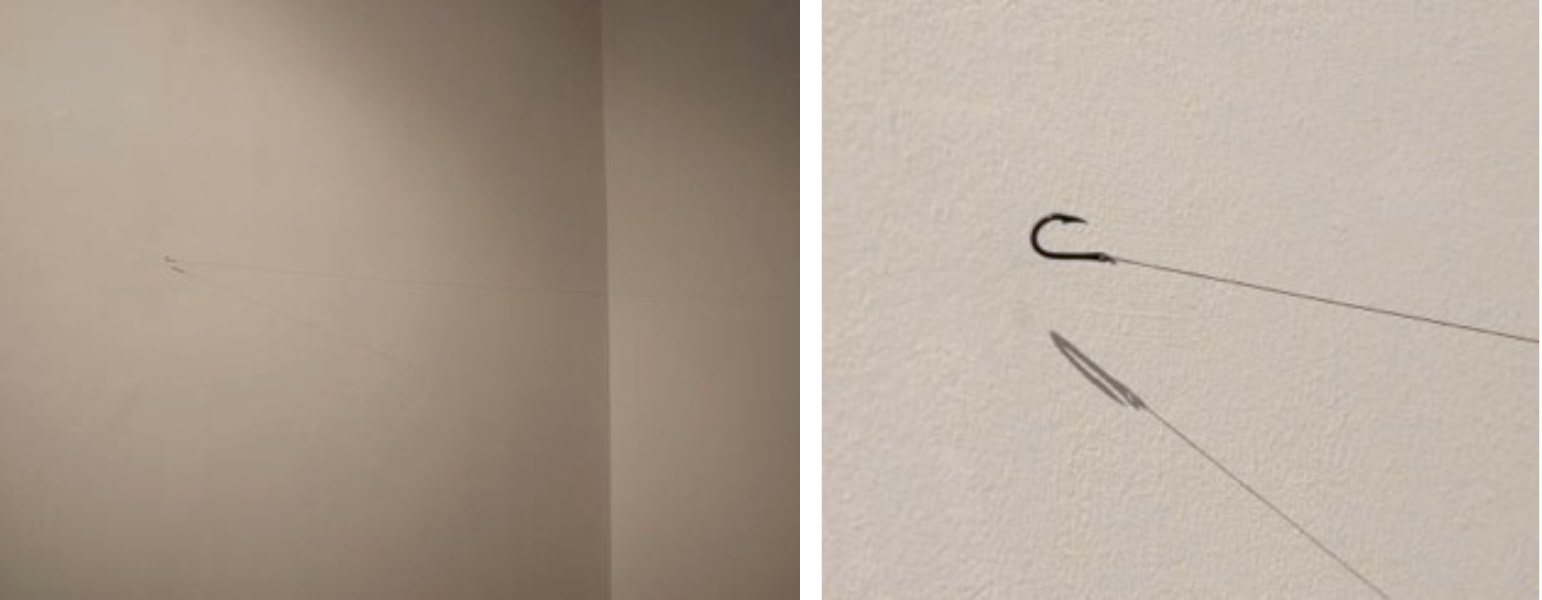
The artist repeatedly refers to this concern of capturing the invisible and traces of the past in his TED talk in November 2009.  A second work, Link from 2009, in this show brought this concept home for me. Link is a string that has been stretched horizontally from one wall with a fishing hook at the other end that is suspended in midair. It is a quiet work, minimalistic in its presence, and easy to miss, which I almost did. But once you happen upon it, it is compelling. The curiosity of what holds the hook aloft midair (spoiler alert: there are magnetic plates involved), and the play of shadow from the string is oddly mesmerizing,  making viewers pause and reassess their understanding of space, gravity and their boundaries, which we experience and witness daily.

A. Balasubramaniam, Link, 2009

Link, 2009
String, Fishing hook, and Magnet
Image credit: Talwar Gallery (www.talwargallery.com)

The remaining three works in this exhibition are from 2012, and continue Balasubramaniam’s engagement with the unseen or the intangible and his rejection of the construct of polarizing opposites like light and dark, shadow and form. In Hold Nothing, he uses a cast of his body to create what appears to be a coiled channel between two portals. It is easy to read this as an analogy of the human body. But what I found interesting was how Balasubramaniam has in fact abstracted figural forms in his new work, building on his existing oeuvre. Process and technique remain key to the viewing experience as with his earlier sculptural and two dimensional works, even as the question of perception and traces that drive his work seem no longer to be captured in absentia as much as actualized.

A. Balasubramaniam, Hold Nothing, 2012

Hold Nothing, 2012
Cast from Artist’s body, Fiberglass and Acrylic
Image credit: Talwar Gallery (www.talwargallery.com)

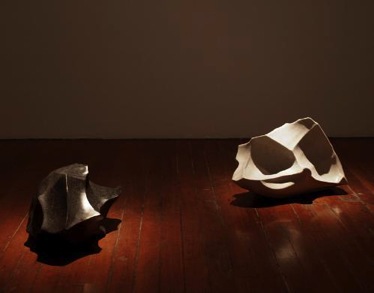
This is also seen in the work Lines in Fold. As the title suggests, this works follows the lines and folds formed by the artist’s closed fists. Carved in unyielding sandstone and granite, this shift in medium is accompanied by an inversion of the content of his sculpture. The inside, so far represented in his oeuvre as absent, is now present and visible, making the skin or the physical layer between the inside and outside redundant.

A. Balasubramaniam, Lines in Fold, 2012

Lines in Fold, 2012
Granite and Sandstone
Image credit: Talwar Gallery (www,talwargallery.com)

This continuum is also evident in Balasubramaniam’s new metal sculptures, which unfortunately were not on view at Talwar New York. They are, however, on exhibit at Talwar Gallery in Delhi.

If you are intrigued by the interface these works create between you and the white gallery walls, watch this video.